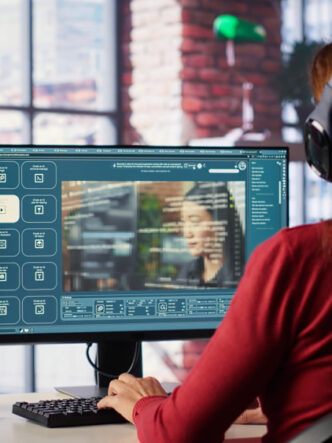


A new trend in e-learning is becoming very clear. Learners prefer human-led e-learning videos. Videos where instructors speak directly into the camera in a relatable, natural way can be very successful because they encourage engagement and trust.
As automation proliferates and AI-generated content seems to be everywhere, it’s no wonder that learners want human connection. They want to see a face, hear a friendly voice, and feel a genuine connection.
Many learners today have grown up watching YouTube tutorials and live streaming of events. These formats are not necessarily perfect but that doesn’t matter if the videos are authentic and emphasize clear communication. As a result of this, learners are more open to instructors who come across as genuine even if their delivery isn’t perfect.
Humans learn from other humans in ways that are difficult for faceless videos to replicate. Seeing other humans speak and picking up emotional cues engages the brain in the mechanics of social learning. These mechanics shape attention, memory, and connection.
For e-learning providers the way ahead is clear – they must provide human-led video content. An online course featuring a visible, expressive instructor will outperform one that relies on faceless narration or animated text. The Cincopa video hosting platform allows e-learning providers to record, host, and brand human-led video content.

Why seeing real humans improves trust and motivation
Learners are unlikely to engage with educational content if they don’t have some kind of trust in who is presenting it. They have a natural tendency to want transparency and emotion from the people to whom they turn to educate them.
Facial visibility
When learners can see the face of an instructor, they subconsciously register different expressions. These cues can help them to decide whether instructors are approachable and whether to trust them. Learners can’t benefit from them in faceless videos, which may not earn their trust.
Tone and body language
For human connection, e-learning instructors use their tone of voice and body language to convey a message. Authentic learning videos with variations in tone can indicate enthusiasm or caution. Their gestures can help to emphasize certain points. A monotone voiceover doesn’t have the layers of communication that come across in human speech.
The accountability factor
When learners feel that they are accountable to a real instructor, they are more likely to complete modules and do assignments. They aren’t left entirely to their own devices, where nobody is checking up on anything they do.
Human presence creates engagement
Learners may feel disengaged when they don’t have instructor presence in online learning. It is harder to ignore an instructor who knows how to close that gap between a learner and the learning experience. Even in asynchronous learning, that human presence can trigger social learning signals.
Emotional cues and presence that strengthen engagement
Learners don’t just process information logically. The human brain responds strongly to visual and auditory stimuli, including facial expressions. Face-to-face communication, even through a screen, is essential for engagement and comprehension.
Decoding meaning
The face of an instructor can give learners signals on how to respond to content. It may be a smile or a raised eyebrow. These expressions can clarify meaning, emphasize importance, and express humor. Without these emotional cues, the material is more difficult to understand.
Mitigating isolation
Online learning can make learners feel isolated and disconnected, which contributes to higher drop-off rates. Human-led videos can help to mitigate feelings of isolation. Learners feel as though they have emotional support and guidance. It helps them to stay engaged for longer, especially when doing a lengthy online course.
Sharing human warmth
Human warmth has a measurable effect on attention. It reduces feelings of monotony and the fatigue employees may feel when doing corporate training. Even embedding a short human-led clip amongst longer modules can revive attention. When learners are alert and emotionally connected, they absorb more and have more recall.
Conveying passion
Learners can absorb the passion of a human instructor for a topic. They can become excited and curious to learn more. Developing a genuine interest in the learning process can encourage them to become continuous learners.

The psychological benefits of instructor-led video
Instructor-led video resonates with some of the fundamental principles of psychology. It isn’t restricted to one type of training but can include everything from webinars and interactive online workshops to multi-session courses.
Social learning theory
According to social learning theory, humans learn when they observe and model other humans. An instructor can demonstrate a particular skill and learners can observe it and model it. The process activates mirror neurons in the brain, which can improve the understanding and application of skills. Learning has always been a social process.
Parasocial interaction
A phenomenon evident on social media platforms is that followers of social media channels feel as if they ‘know’ the presenters. They form one-sided relationships with figures they watch constantly. As an online educator, you can use this phenomenon to increase learner trust. Video on your e-learning platform led by an engaging instructor can result in a stronger emotional investment from learners and higher course completion rates. They may even return to your platform to purchase additional courses.
Memory encoding
Instructor-led videos can boost memory encoding. It isn’t just about the material but about the way in which it’s presented. When learners picture an instructor cracking a joke or emphasizing a point with a gesture, it is easier to remember the associated information.
Consistency
Instructor-led videos can offer consistency in corporate training. For example, every new hire can receive the same instructor-led training regardless of location and team or department. All it requires is providing them with a link to the appropriate video content. This isn’t what happens with in-person corporate training, where new hires in different departments may have different instructors who vary in competency and consistency.
Feedback and reinforcement
Learners remember more when they receive feedback and reinforcement of concepts. Instructors can use video messaging to communicate and offer learners feedback so they can identify their mistakes and correct them. The feedback should always be time-appropriate and constructive. Learners can apply it straight away and make good progress.
Learners can listen to live webinars in elearning and then watch these webinars again as video-on-demand (VOD). Instructors can save them in an on-demand content hub. They can edit them and add interactive elements so they become evergreen content that learners can watch when it suits them.
Learning by doing
Learners should be active participants in the learning process. They need to engage in hands-on activities that get them moving and reflecting on the material. E-learning video personalization often involves using interactive elements like branching scenarios and quizzes. Videos with multiple paths allow learners to choose which path to take and this determines what happens next. Q&A sessions, polls, and surveys are some other interactive elements instructors can use.
Driving motivation
When learners aren’t motivated, they are likely to do the bare minimum. It helps to have instructors who can explain the real-life application of training. When they understand how it can help them in their lives, they are more motivated. Instructors can help learners to set goals so they feel like they’re working towards achievements that are meaningful to them.
Self-regulation
Using instructor-led videos doesn’t mean that learners aren’t in control of their own e-learning experiences. They need to exercise skills such as organization, self-control, etc. Instructors can encourage them to choose a learning method they prefer, organize their schedules, and take adequate breaks. As e-learning programs become more learner-centric, the above are some of the main psychological principles that apply.
Using the built-in analytics on a platform like Cincopa gives you the opportunity to analyze instructor-led online courses or training. This can give you insights into factors like course completion, drop-off rates, and much more. You can use these insights to increase the effectiveness of training.
Conclusion – Human-led content as a differentiator in e-learning
Human-led e-learning videos are effective because they inject presence, warmth, passion, and more into e-learning. This can be missing when videos aren’t human-led. They can make learners feel isolated, disconnected, and lacking in motivation. Go to Cincopa home page and sign up for a free trial so you can find out more about how it will help you to offer human-led video content in e-learning.