

Choosing a media management platform that fulfills all your media requirements relies on whether you need a developer-focused media infrastructure or interactive tools for eLearning. Cincopa helps with training and education, while Cloudinary helps with media optimization for e-commerce. If you want a platform that fits your needs (such as balancing usability, interactivity, and developer control), this Cincopa VS Cloudinary comparison breaks down where each platform shines and where limitations may arise.
| Category | Cincopa | Cloudinary |
| Target Audience | Educators, training providers, and institutions who are searching for learner-focused and structured video delivery. | Wnterprises and development teams that need large-scale media delivery and management APIs, in content-heavy and e-commerce apps. |
| Galleries & Player Management (Enables organizing media into collections and managing how it is delivered through players.) | Organize media into well-formatted galleries for the use of customizable players and structured viewing with playlist options. | Lacks playlist management and native gallery, yet offers a basic JavaScript player SDK for developers to customize. |
| Editor (Temp Name) (Allows you to manage and edit media for better organization.) | Add the meta editor to your platform. | Resizing, optimization, compression, and format conversion for rich visual libraries and handling product catalogs. |
| Players (The playback interface where the users watch media, with rich options to personalize its features and look.) | Deliver content using customizable players that support branding, playlists, and flexible layouts. | Basic player SDK that requires developer programming for customization. |
| Analytics (Tracks and measures user engagement with media content.) | Monitors user engagement with media content using standards, such as heatmaps, play rate, watch time, IP information, and device type. | Technical Playback & Delivery Analytics (quality of service and possible errors). |
| E-learning Specific Feature (Adds interactive elements (like CTAs) within content for training & learning purposes.) | Improve learning with CTAs, lead forms, in-video quizzes, AI transcription, clickable hotspots, and subtitles. | Not available. |
| Media Support (Specifies the media formats supported by the platform.) | Supports various media formats, such as audio, video, documents, and images. | Videos and Images only. |
| CMS Integration (Allows direct integration with content management systems for publishing workflows.) | Integrates with both traditional CMS (like HubSpot & WordPress) and headless CMS platforms (like Strapi & Sanity). | Developer frameworks & CMS are supported. However, LMS workflows need custom setup or middleware. |
Video Player & Customization
Cincopa
Cincopa includes a built-in HTML5 player to support playlists, single videos, and advanced layouts, like a course-style format. The Cincopa player helps educators turn playlists into lesson modules and create structured learning paths with chapter markers for easy-to-follow navigation.
For instance, a playlist can be a series of lessons within a module. On the other hand, chapter markers help learners navigate to specific topics without having to lose context.
Annotations, guided prompts, and in-video pop-up quizzes are some examples of interactive elements that can be integrated into the playback. Instead of passively viewing, learners can engage with their video lesson.
Cloudinary
Cloudinary has different style players. However, the company does not provide a native interactive player but rather a player SDK based on JavaScript that developers can customize with their own code. The platform is perfect for media optimization and transformations for programmatic management of media content.
The player of the company supports accessibility compliance, adaptive bitrate streaming, branding, custom skins, chapters, interactive elements, as well as subtitles. Integration with Cloudinary’s media delivery, transformation, and management features allows businesses (including e-commerce teams) to create custom video experiences for mobile as well as web audiences.
Media Management
Cincopa
Cincopa provides centralized media management characteristics with playlist creation, galleries, and inline editing. By using annotations and chapters, users can arrange videos in a logical way for easy browsing. The platform is compatible with different media types, such as images, audio, video, and documents. Thus, users can save and manage the educational materials in a centralized way.
Cloudinary
Cloudinary manages the full cycle of media assets, starting from uploading and organizing, followed by optimizing, delivering, and transforming to different digital channels. Besides, it offers software-driven tools powered by AI, a Media Library UI, and APIs for the simplification of the workflow and the provision of fast and efficient media delivery.
Integrations
Cincopa
Cincopa combines with LMS systems like Moodle, helping educators to add multimedia content within their courses. This allows them to create richer lessons, where educators can include lectures, such as visual demonstrations, recorded discussions, and video explanations, along with standard course materials.
With this, learners can record or upload multimedia such as audio, images, or videos, while educators can listen to or view the submissions within Moodle and grade them without downloading them first.
Cloudinary
Cloudinary integrates with well-known CMS platforms, e-commerce tools, and frameworks like Shopify. This makes it well-suited for brands to deliver optimized product videos & images on various marketing channels, mobile apps, and storefronts. However, certain specialized usage scenarios (e.g., eLearning or LMS workflows) require middleware or API logic to make the course platforms work with Cloudinary’s media processing.
Usability
Cincopa
Cincopa is designed for both non-technical and technical users. The platform provides an easy-to-use interface with pre-built templates, such as media galleries & video course players tailored for eLearning use cases to create structured video experiences.
It also includes built-in tools, including attendance tracking, in-video pop-up quizzes, and analytics dashboards. These analytics dashboards help educators understand how learners interact with each course, spot the areas where attention decreases, and make appropriate changes in the curriculum.
Cloudinary
Cloudinary needs developers’ involvement for setup, configuration, as well as daily use. Media workflows (like media analytics) are managed using code-based integration or APIs rather than a simple interface. This approach is good for e-commerce teams managing large product catalogs. Here, optimized media delivery across mobile, marketing, and web channels helps with conversions & performance.
Case Study
Cincopa
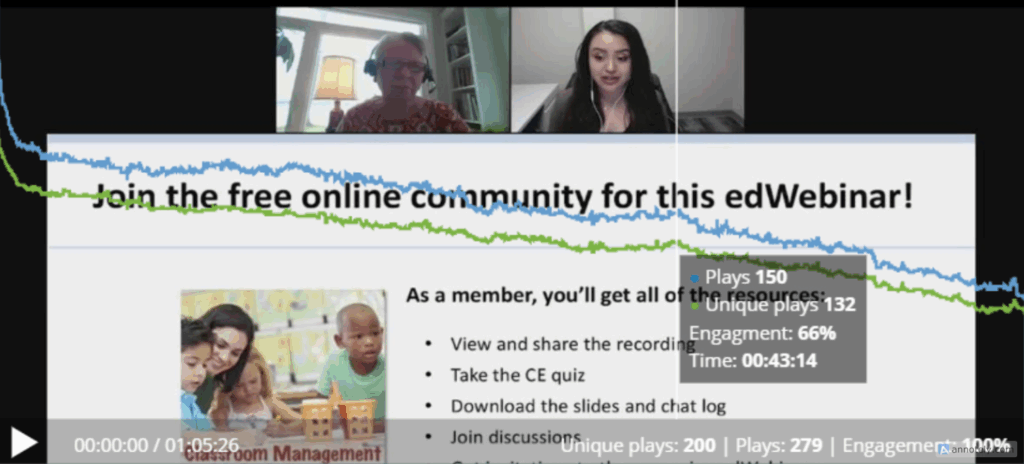
edWeb.net is a free & professional learning community that hosts around 75 educator communities along with a library of approximately 2,000 one-hour webinars, which averages 65,000 monthly viewers.
Initially, edWeb has been using a third-party platform to redirect users off-site. But it lacked mobile tracking (despite 30% of users using mobile), and delivered viewership data every 2 weeks via spreadsheets. This lacked real-time integration and delayed certification with edWeb’s CRM.
Cincopa replaced this system by introducing an on-site video hosting solution along with real-time tracking. Now, data flows into edWeb’s CRM to allow a 48-hour certificate turnaround. Cincopa has created dedicated webinar landing pages to engage viewers on-site and brought in AI-generated closed captions along with an SRT editor that helps editors to finalize and publish content.
Cincopa’s analytics part helps edWeb verify if a learner has completed a webinar, which is necessary for professional development credit.

- Cincopa Case Study
Cloudinary
Mattel is a prominent global toy and family entertainment company, like Barbie, Hot Wheels, Fisher-Price, American Girl, and UNO, with a reach of millions of consumers across the globe.
Back in 2021, Mattel was dealing with digital workflows that were out of date and a monolithic technology stack. Asset management was not only slow but also disorganized and lacked governance. Thus, this resulted in long loading times on the most important websites, such as shop.mattel.com and americangirl.com. High-demand events like flash sales were experiencing timeouts and page load failures, while internal teams were having trouble delivering new products & visual experiences.
Consequently, Mattel has partnered with Cloudinary, a part of its all-digital MACH-based modular technology stack, to overhaul its digital operations. Cloudinary’s API-first platform is enabled. It allowed them to integrate with other software packages, including Shopify and Contentstack. Besides, the company could use AI-powered image and video optimization, transformations, and delivery without much difficulty. The adaptability of this platform allowed Mattel to handle media better and deliver it through the web, mobile, as well as retail touchpoints.
In addition, Mattel has improved site performance when traffic volume is high. It uses the Cloudinary platform to fulfill image and video requests at a high rate daily. American Girl is a brand that has benefited from the platform, as real-time online and in-store personalization is now possible. As a result of the partnership with Cloudinary, Mattel can expand its presence worldwide, cut down load times, provide creative storytelling experiences, and offer top-quality media as well as e-commerce services to attract engagement and online conversions from its digital and retail channels.
Video APIs
Cincopa
Cincopa provides developer APIs to upload & manage media, create & customize video experiences, and access media analytics. The APIs support both on-demand & live streaming, and you can test them directly from the documentation.
Cloudinary
Cloudinary provides numerous Video APIs to manage, change, optimize, and deliver video content of any size. Its cloud-based, API-first platform automates the video lifecycle (from upload & storage to advanced transformations & delivery), helping even e-commerce teams to handle product videos across web & mobile channels.
Features
Cincopa
The learners have to actively interact with the material and don’t passively watch the videos when interactive features are implemented. For this, Cincopa has introduced native features to enhance video presence in educational settings, and it is all through:
Quizzes – With embedded quizzes, learners can test themselves instantly and hence deepen their grasp of the learned material.
Clickable Hotspots – Users may be taken to a new webpage, get more information, or move to another part of the content/presentation by clicking on a hotspot.
Calls-to-Action (CTAs) – Trainers may attach CTAs to direct learners right away to extra materials such as eBooks, infographics, or videos on the same topic.
Video Editing & Accessibility Tools – Videos can be cut, divided into chapters, and improved with AI-powered transcription and subtitles. Thanks to these features, learners have access to note-taking, quick topic review, and contribute to the general accessibility.
Replace Asset – This feature allows you to upload the updated version of a file while maintaining the same embed code and sharing links. The updated version is available immediately, without the need for re-embedding or re-sharing.
Analytics – This feature offers video analytics that allow learning institutions to check audience engagement and monitor performance, without which the tools are unnecessary. In addition, it gives instructors data support to reshape the course content.
Set Thumbnail – Through videos, educators can pick a personalized thumbnail for every clip. Thus, it ensures that the first frame learners have access to relevant and visually attractive to them.
For more interactivity and engagement features, you can explore Introducing Cincopa documentation.
Cloudinary
Cloudinary provides a visual and video digital asset management solution that includes upload, storage, optimization, transformation, and delivery via its CDN. The main features are transformations, AI tools (such as automatic tagging), automated optimization, and APIs for integration, as well as a DAM system that assists the e-commerce teams not only in managing product visuals but in marketing media too.
Security
Cincopa
Cincopa secures video content with AES encryption and access controls, ensuring content is only viewable on approved sites or networks. Access controls can be applied with domain and IP whitelisting, ensuring that videos are only viewable on approved sites or networks.
Cincopa uses a proprietary streaming protocol to limit the playing of files to the Cincopa Player, thus blocking any third-party access. As well as that, the admins can authorize the downloads per file, allowing them to decide which content to release.
Moreover, Cincopa not only equips clients with watermarking capabilities, but also firms with the possibility to imprint their brand or an exclusive feature directly on the videos. For educators and training providers, this is especially useful for protecting instructional material and maintaining brand presence across courses and shared resources.
Cloudinary
Cloudinary secures media using signed URLs, access controls, secure uploads, and protected storage with backups & version history. Signed URLs provide temporary, encrypted access for authorized users, and server-side or client-side upload methods ensure safe content handling. These features facilitate the work of e-commerce teams in protecting product media against unauthorized access and, at the same time, in securely delivering them to customers.
Reviews & Testimonials
What users are saying about Cincopa:
Educators often cite Cincopa’s ease of use and rich feature set as key benefits.