Why Employees Keep Asking in Slack When the Answer Is Already Documented

An answer can be documented and still be difficult to find, trust, or apply. Repeated questions can show teams where their internal knowledge needs a clearer path, better context, or an accountable owner.

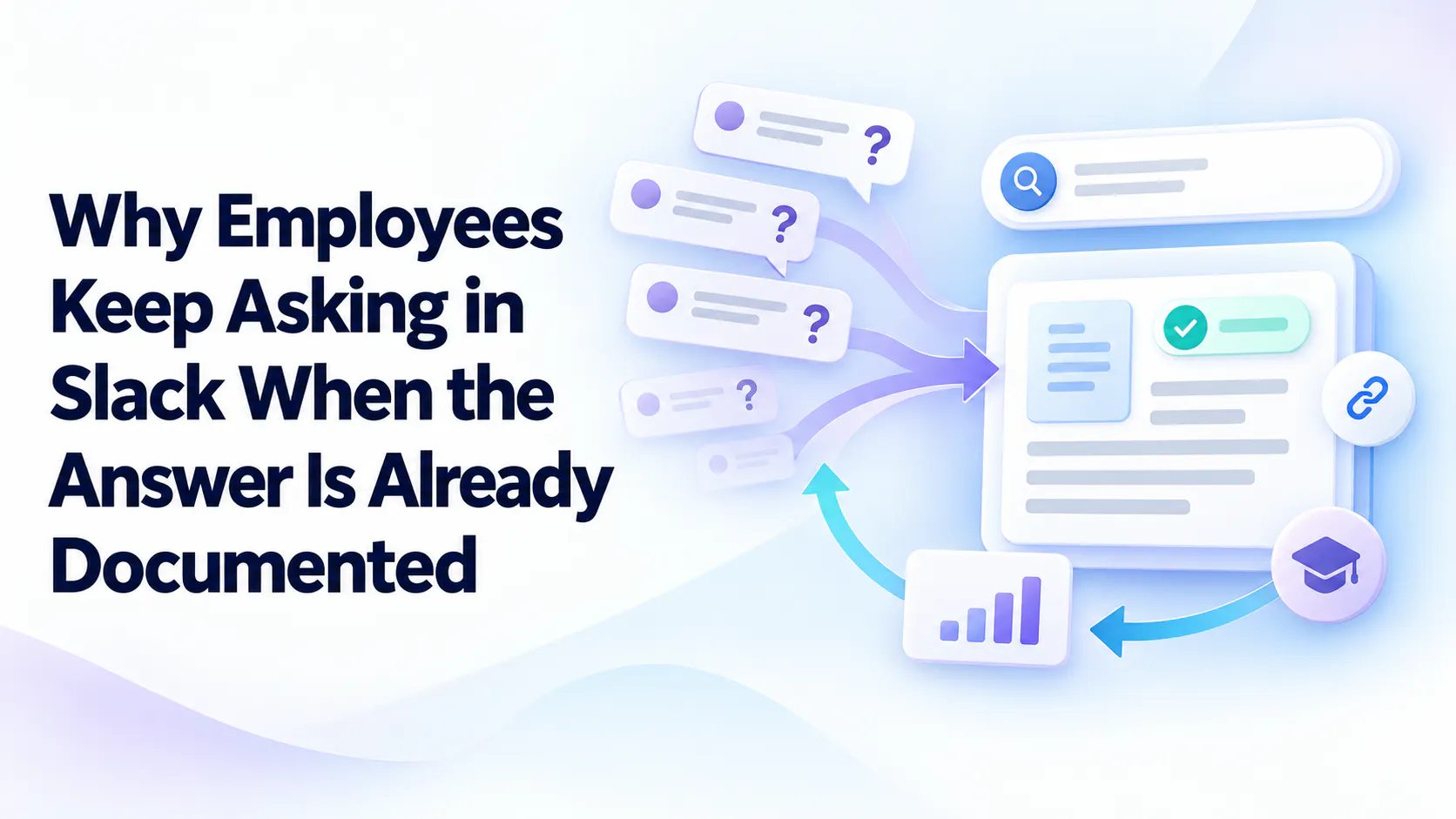
Repeated employee chat questions connected to searchable, verified documentation and a source-improvement feedback loop.

The answer exists, but asking still feels easier

Consider a hypothetical new employee, Maya, who needs access to a customer support reporting tool. Her onboarding checklist links to a guide, but the guide names a manager who has changed teams. A second page describes a different request process. Maya posts in Slack: “Who approves reporting access now?” A colleague answers in minutes and confirms which form to use.

From Maya’s perspective, asking was a sensible way to finish the task. The documentation existed, but it did not provide a dependable answer. Her colleague supplied something the pages lacked: confidence that the instructions applied today.

Repeated questions like this can reveal friction in the knowledge system. The goal is to understand what made asking necessary, then improve the source while preserving the conversation that helped someone move forward.

Employees do not know where to look

An employee may face a wiki, shared drives, an HR portal, team channels, and a recording library before even beginning a search. Knowing an answer exists somewhere does not tell them which system contains the approved version. Each unsuccessful attempt makes a direct question more attractive.

Organization also matters. Authors may file a guide under “Identity Operations,” while employees search for “request reporting access.” Department names and internal project terms are useful to their owners but unfamiliar to newcomers. A page title should describe the task in language its intended reader would use.

In Maya’s hypothetical team, a clear onboarding starting point could link to “Request access to support reporting.” That small navigation change would remove an unnecessary choice without requiring every department to move its documentation into the same tool.

Finding a page does not mean trusting it

A relevant search result can still raise doubts. Old screenshots, an absent owner, broken links, and conflicting versions make readers wonder whether following the instructions will create more work. Previous encounters with incorrect guidance can make people seek confirmation even when the next page looks reasonable.

A recent edit date is not proof of accuracy. Someone may have corrected spelling without testing the procedure. Show a meaningful review status: who checked the instructions, when they checked them, and which environment or process the review covered.

Maya’s guide needs an accountable owner and a verified approval route. Simply changing its date would leave the same uncertainty. Where two versions disagree, an owner should resolve the conflict and direct readers to the authoritative instructions.

The documented answer may not fit the situation

Instructions often depend on details that a general page leaves unstated. A contractor may need a different approval from an employee. Administrators and standard users may see different controls. Region, application version, and data sensitivity can change which procedure is appropriate.

Readers ask for confirmation when they cannot tell whether an exception applies. Add prerequisites, intended roles, and decision points near the relevant step. Explain when to stop and ask an authorized person rather than encouraging readers to improvise.

For Maya’s team, the updated access guide might separate standard reporting access from access to restricted customer information. One clearly labeled exception is more useful than a growing collection of nearly identical pages with ambiguous titles.

Slack provides reassurance and context

A colleague can interpret an unclear request, ask a follow-up question, and explain why a rule applies. Slack also makes the answer visible to others who may share the same uncertainty. That interaction has value even when an article covers the basic steps.

Some conversations should remain human. Approval decisions, unusual exceptions, sensitive information, and situations requiring professional judgment cannot always be reduced to a self-service procedure. Documentation can explain who makes the decision and what information they need.

The aim is to remove avoidable uncertainty while keeping a useful route to people. In Maya’s case, a guide can explain the normal access process; the authorized approver still decides whether her requested permissions are appropriate.

Diagnose what repeated questions are telling you

Treat repeated questions as prompts for investigation. The same visible behavior can have several causes: an unclear title, missing access, an unusual situation, or a procedure that no longer works. Ask what the employee tried before deciding which change is needed.

Possible causes to investigate

Repeated question or behavior
Likely documentation problem
How to investigate
Improvement to the source
“Where is the leave policy?”
The policy may be difficult to discover.
Ask which terms and starting point the employee used.
Add familiar terms and link the policy from the HR starting point.
“Which escalation procedure is correct?”
Two versions may conflict.
Compare audience, review status, and instructions with the owner.
Resolve the conflict; merge duplicates or label valid variants.
“Who approves reporting access?”
The request route or scope may be unclear.
Check the form, current approver, and role requirements.
Update the access guide and its onboarding link.
“Was this covered in training?”
A recording may be overlooked or poorly labeled.
Check titles, descriptions, access, and where the answer occurs.
Add task-based labels and link the relevant segment where supported.
“Does this apply to contractors?”
A necessary exception may be absent.
Confirm the rule with the authorized owner.
Add the exception and explain when human approval is required.
“Where is the leave policy?”
Likely documentation problem
The policy may be difficult to discover.
How to investigate
Ask which terms and starting point the employee used.
Improvement to the source
Add familiar terms and link the policy from the HR starting point.
“Which escalation procedure is correct?”
Likely documentation problem
Two versions may conflict.
How to investigate
Compare audience, review status, and instructions with the owner.
Improvement to the source
Resolve the conflict; merge duplicates or label valid variants.
“Who approves reporting access?”
Likely documentation problem
The request route or scope may be unclear.
How to investigate
Check the form, current approver, and role requirements.
Improvement to the source
Update the access guide and its onboarding link.
“Was this covered in training?”
Likely documentation problem
A recording may be overlooked or poorly labeled.
How to investigate
Check titles, descriptions, access, and where the answer occurs.
Improvement to the source
Add task-based labels and link the relevant segment where supported.
“Does this apply to contractors?”
Likely documentation problem
A necessary exception may be absent.
How to investigate
Confirm the rule with the authorized owner.
Improvement to the source
Add the exception and explain when human approval is required.

A short record of the question, source, suspected gap, and responsible owner is enough to begin. Review recurring patterns together instead of treating every message as a separate documentation request.

Improve the source while answering the question

Answer the immediate question first when you can do so accurately and within the appropriate permissions. Include a concise explanation and a direct link to the relevant source. If the source is wrong or incomplete, acknowledge that gap instead of presenting the link as sufficient help.

Then identify what prevented the employee from using it. Was the page hard to find, unclear about audience, or missing a current approval step? Assign the correction to an owner who can verify the answer. Update or merge the existing guidance when it serves the same task rather than creating another competing page.

Answer the question → link the source → identify the gap → assign an owner → update or merge → test discovery and understanding.

In the hypothetical example, Maya’s colleague answers with the correct form, flags the obsolete approver, and asks the support operations owner to check the guide. The owner merges the conflicting pages, adds the restricted-access exception, and updates the onboarding link. A second new starter then tests whether the revised guide is findable and usable.

Make recordings and supporting materials easier to discover

Answers can remain hidden inside an onboarding recording, a walkthrough, or a PDF even when everyone can open the file. A title such as “Tuesday training” gives little indication that the session explains reporting permissions. Readers may not know which recording to watch or where the useful explanation begins.

Use task-based titles and descriptions, connect recordings to maintained procedures, and identify the audience and review status. Chapters or relevant timestamps can help readers reach a specific explanation when available. Check that linked supporting materials are accessible to the intended employees.

Cincopa is one example of a platform for organizing video and supporting materials into knowledge collections. A team can connect an appropriate collection to its documentation starting point. This does not imply automatic indexing of Slack, synchronization of every external tool, or search across all company documentation.

Encourage better habits without discouraging questions

Make the preferred behavior easy: provide a clear starting point, recognizable task names, visible owners, and an obvious way to report a problem. Explain where approved guidance belongs so employees can contribute improvements without creating another isolated source.

Helpful replies can model the habit: “Use this form for standard reporting access; the guide explains the restricted-data exception.” That gives the person an answer and a reusable source. Repeatedly pasting a link to an unhelpful page teaches little and leaves the underlying issue unresolved.

Invite people to mention what they searched for and where they became stuck. Use that context to improve titles, navigation, and content. Avoid public shaming or blanket restrictions on questions; silence can hide uncertainty and prevent necessary escalation.

Measure whether employees can get reliable answers

Test common tasks with representative employees. Can they find the right source, recognize that it applies, and complete the next step? Observe time to a usable answer, successful searches, requests for clarification, and feedback about missing or inaccurate instructions.

Track repeated questions about the same unresolved gap, source corrections, and whether owners complete agreed updates. For Maya’s team, the useful test is whether another new starter finds the current form and understands when approval differs. A lower message count alone cannot demonstrate that.

Question volume is ambiguous. Fewer messages may indicate better documentation, or employees may have given up or moved into private conversations. More questions may reflect new hires or healthier reporting. Interpret the numbers alongside task outcomes and employee feedback.

Frequently asked questions

Why do employees ask in Slack instead of searching the knowledge base?

Asking may feel faster or safer when sources are scattered, hard to find, outdated, or unclear about the employee’s situation. Investigate what the person tried before assuming they ignored the documentation.

Should we ask employees to search before posting?

Encourage a quick search through a clear starting point, but keep questions welcome. Invite employees to share unsuccessful search terms so the team can improve discovery.

How should we respond when the answer is already documented?

Give a concise answer with the relevant source and clarify its scope. If the page was difficult to use, capture the gap and arrange a correction rather than only repeating the link.

Should every Slack answer become a knowledge base article?

No. Update existing guidance for recurring, reusable knowledge. Keep one-off approvals and sensitive discussions in appropriate channels, and avoid creating duplicate pages for minor variations.

Can AI solve repeated internal questions?

AI may help retrieve or explain supported source content when configured appropriately. It still depends on accurate guidance, access controls, and clear scope. It cannot establish authority for conflicting procedures or replace required human approval.

How can we tell whether the documentation is improving?

Repeat practical find-and-use tests, review employee feedback, and check whether known source gaps are resolved. Look for reliable answers and successful tasks alongside search and question patterns.

A practical takeaway

Make the documented answer easier to find, trust, and apply. Answer employees helpfully, use repeated questions to identify gaps, and give an owner responsibility for improving the source. Useful human discussion can strengthen the knowledge system instead of competing with it.