Ask YouTube for Private Videos: What Organizations Need Beyond Consumer AI

If you want an Ask YouTube-like experience for private organizational content, the requirement is not simply a chat button beside one video.

You need a governed video knowledge system that answers from approved videos and documents, respects permissions, links people to the source, and shows your team what users are asking and what knowledge is still missing.

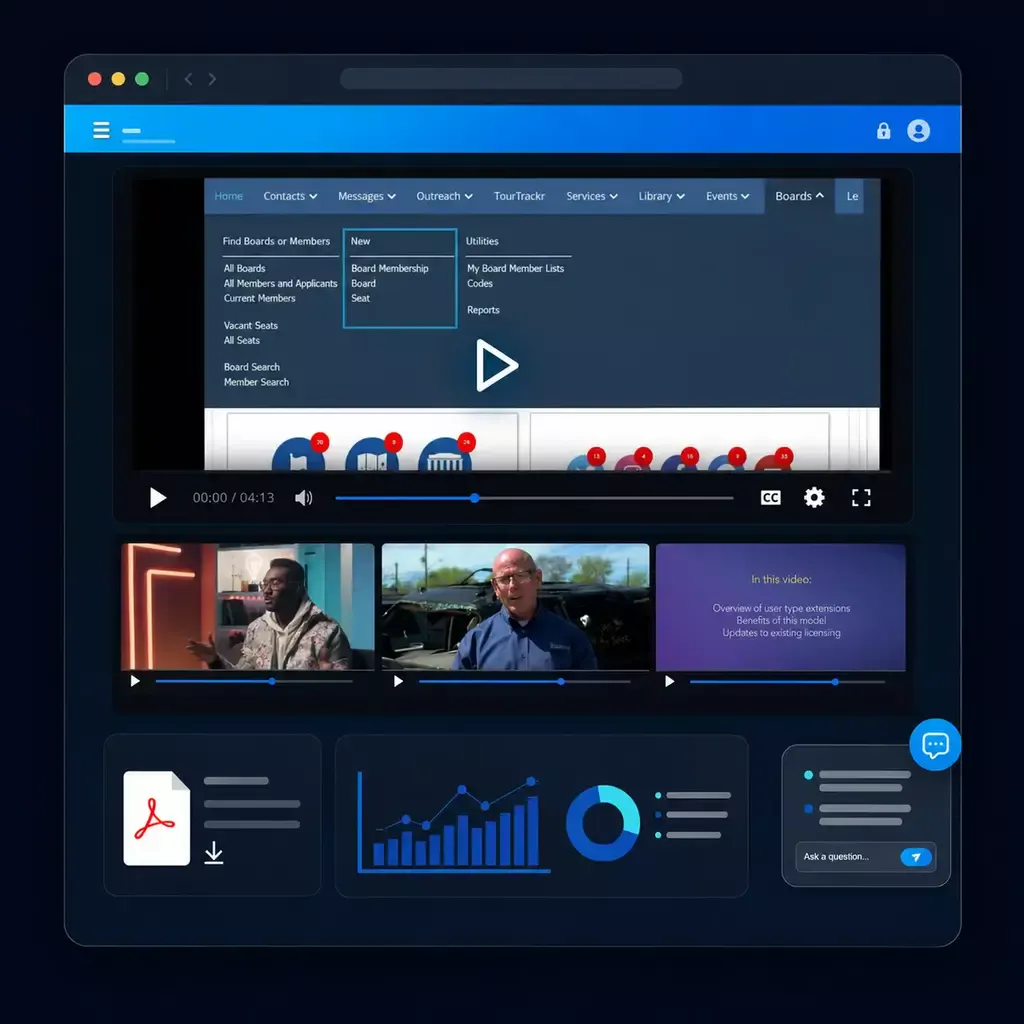
Private organizational video knowledge page with training video, related content, a supporting PDF, analytics, and an AI question interface

What Does Ask YouTube Do?

Ask YouTube on the watch page

Ask YouTube on the watch page lets eligible signed-in viewers ask questions about select videos while they watch. Viewers can type a question or choose a suggested prompt, and YouTube may also recommend related content.

This experience is useful because it replaces timeline scrubbing with a natural-language question. However, YouTube controls where it appears, which videos are eligible, and how the experience works.

Search with Ask YouTube

Search with Ask YouTube is a separate, newer conversational search experience. It can draw from the wider YouTube catalog and real-time web information, combine written answers with videos or clips, and accept follow-up questions.

The distinction matters: the watch-page tool focuses on the viewing experience around a selected video, while the search experiment explores YouTube and the web. Neither is documented as a governed knowledge system built around an organization's approved private videos and documents.
Why a Private Organizational Version Is Different

The requirement is not merely private playback

A private YouTube alternative can hide videos from the public, but an organizational AI video Q&A system must solve a larger problem. It needs to control who can ask, which sources can be used, what evidence supports each answer, and what administrators can learn from the interaction.

For internal training, product education, customer support, partner enablement, and workflow documentation, the important requirements usually include:

  • A library selected and approved by the organization
  • Permissions that match the intended employee, customer, or partner audience
  • Question answering across multiple videos and supporting documents
  • Grounded answers with links to the relevant video moment or PDF
  • Organizational visibility into question and answer history
  • Analytics that expose repeated questions, weak answers, and missing knowledge

Private video Q&A is a knowledge system

The best way to think about this is not "YouTube, but hidden." It is a private video knowledge base: an environment in which approved recordings, transcripts, chapters, metadata, and documents become searchable and answerable.

That makes the experience useful before a viewer knows which video contains the answer. It also lets the organization improve the library from real questions instead of relying only on views, watch time, or editorial guesses.

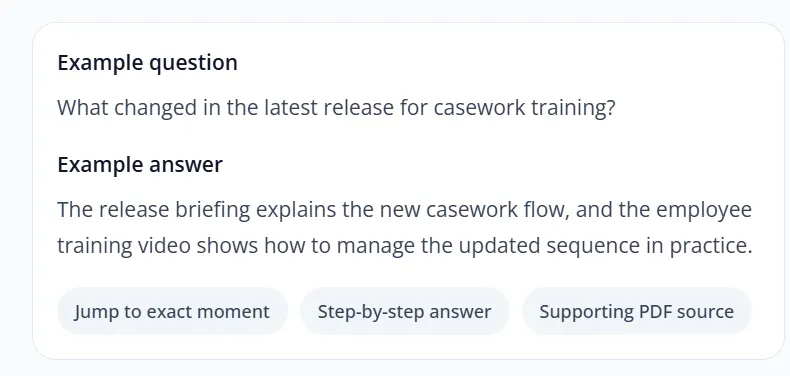
Example organizational question answered from a training video and supporting PDF with an exact-moment source link
An organizational question can be answered from approved videos and documents, then linked back to the exact source moment.

Ask YouTube vs. Private Organizational Video Q&A

The practical difference

Ask YouTube makes conversational video discovery familiar. An organization needs additional control over its audience, knowledge scope, history, evidence, and improvement process.

Capability
Ask YouTube
Private organizational video Q&A
Knowledge scope
The current watch-page video, or the wider YouTube catalog and web in the separate search experience
A defined collection of approved videos, transcripts, PDFs, metadata, and supporting documents
Access and availability
YouTube decides user, region, language, video, and feature eligibility
The organization defines audiences, permissions, environments, and available collections
Question visibility
YouTube documents individual activity controls, but not an organization-facing Q&A analytics console
Authorized teams can review questions, answers, sessions, and recurring patterns
Gap analysis
No documented creator dashboard for weak answers or missing organizational knowledge
Repeated, weak, or unanswered questions become a content improvement roadmap
Sources and evidence
YouTube selects content within its own experiences
The organization controls the approved sources and can link answers to exact video moments or documents
Deployment
The YouTube interface
The organization's website, help center, intranet, training portal, or private video portal
Knowledge scope
Ask YouTube
The current watch-page video, or the wider YouTube catalog and web in the separate search experience
Private organizational video Q&A
A defined collection of approved videos, transcripts, PDFs, metadata, and supporting documents
Access and availability
Ask YouTube
YouTube decides user, region, language, video, and feature eligibility
Private organizational video Q&A
The organization defines audiences, permissions, environments, and available collections
Question visibility
Ask YouTube
YouTube documents individual activity controls, but not an organization-facing Q&A analytics console
Private organizational video Q&A
Authorized teams can review questions, answers, sessions, and recurring patterns
Gap analysis
Ask YouTube
No documented creator dashboard for weak answers or missing organizational knowledge
Private organizational video Q&A
Repeated, weak, or unanswered questions become a content improvement roadmap
Sources and evidence
Ask YouTube
YouTube selects content within its own experiences
Private organizational video Q&A
The organization controls the approved sources and can link answers to exact video moments or documents
Deployment
Ask YouTube
The YouTube interface
Private organizational video Q&A
The organization's website, help center, intranet, training portal, or private video portal

Control Who Can Ask and What the AI Can Use

Access control defines the audience

An employee, customer, reseller, and support agent should not automatically see the same content. A private system should connect identity and permissions to the relevant library, page, channel, or portal.

For example, customers may receive product onboarding and troubleshooting content, while support agents can access internal escalation instructions. Regional partners may need a collection that differs from the one used by direct customers.

Knowledge scope defines the allowed evidence

For organizational video question answering, the AI should normally work from a deliberate collection of approved sources rather than the public web. Depending on the use case, that collection can include:

  • Product walkthroughs, training videos, webinars, and meeting recordings
  • Transcripts, captions, chapters, titles, descriptions, and tags
  • Operating procedures, manuals, policies, and other supporting PDFs
  • Approved onboarding, support, and partner enablement material

Access answers who may use the system. Scope answers what the system is allowed to use. A trustworthy private deployment needs both.

Search the Approved Library, Not One Video at a Time

The viewer may not know which video contains the answer

An employee may remember that a workflow was explained in a workshop but not know which recording contains it. A customer may have a setup question without knowing whether the answer lives in an onboarding video, a troubleshooting clip, or a PDF.

Library-wide AI video search lets the user ask first. The system searches the permitted collection and identifies the strongest available source. That is different from opening videos one at a time and asking each one separately.

Typical questions include:

  • Where was the new approval workflow explained?
  • Which training covers role-based permissions?
  • How do I resolve this installation error?
  • What changed in the latest release, and where can I see the new process?

Answers should lead back to evidence

For technical, visual, or procedural questions, a generated paragraph is not always enough. A useful answer should show where the information came from and let the viewer verify it in context.

  • Answer from the approved source material.
  • Identify the supporting video, transcript, or document.
  • Deep link to the relevant moment in the video.
  • Let the viewer continue with relevant follow-up questions.

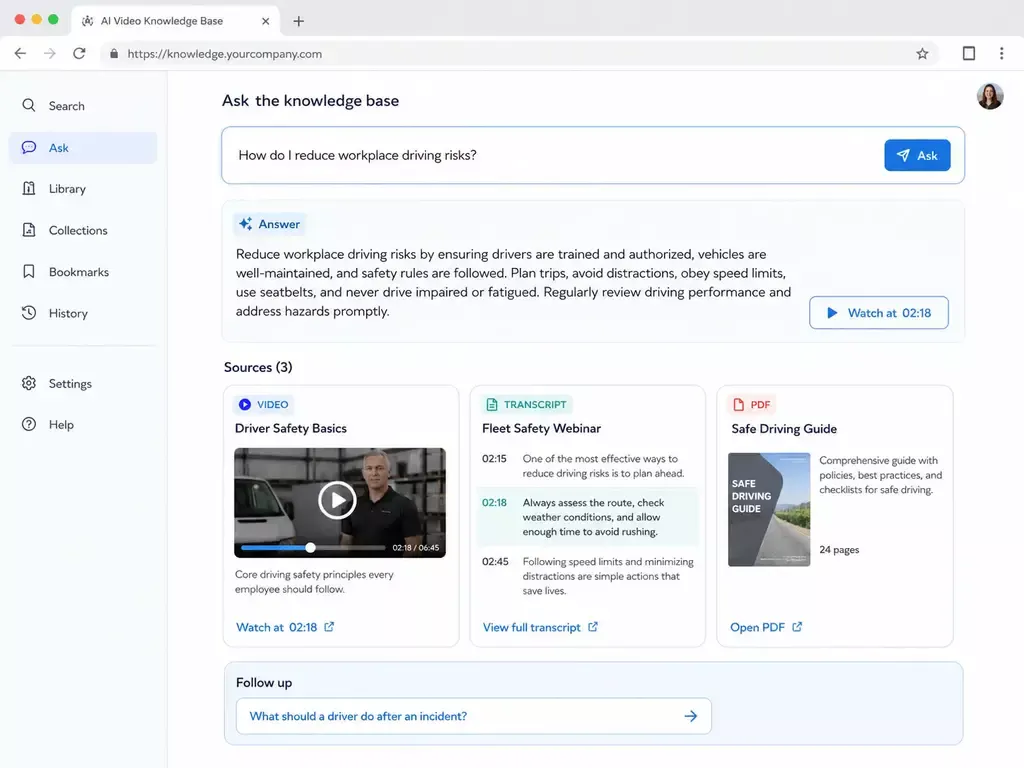
Cincopa VideoGPT can answer across an approved video and document collection and guide the viewer to the relevant source rather than returning an unsupported response.

VideoGPT answer grounded in multiple approved video and document sources
A library-level answer can be grounded in several approved videos and supporting documents.

Make Question and Answer History Visible to the Organization

Individual activity history is not organizational intelligence

YouTube documents activity controls for individual users. For watch-page conversations, YouTube says account-connected conversations are automatically deleted after 45 days. It also states that some disconnected conversations reviewed by people may be retained separately for up to three years and advises users not to submit confidential information.

This is not a criticism of a consumer service. It is a different governance model. YouTube's current documentation does not describe a creator-facing or organization-facing console for reviewing viewer questions, exporting answer history, or analyzing gaps in a company's private knowledge.

What organizational knowledge owners need to see

Depending on policy and user consent, authorized administrators may need visibility into:

  • The question and answer
  • The source environment, such as a Gallery, Page, channel, or portal
  • The videos and documents used as evidence
  • The conversation path and useful follow-up questions
  • Answer feedback, weak responses, and unanswered needs
  • Aggregate patterns across users, teams, products, or topics

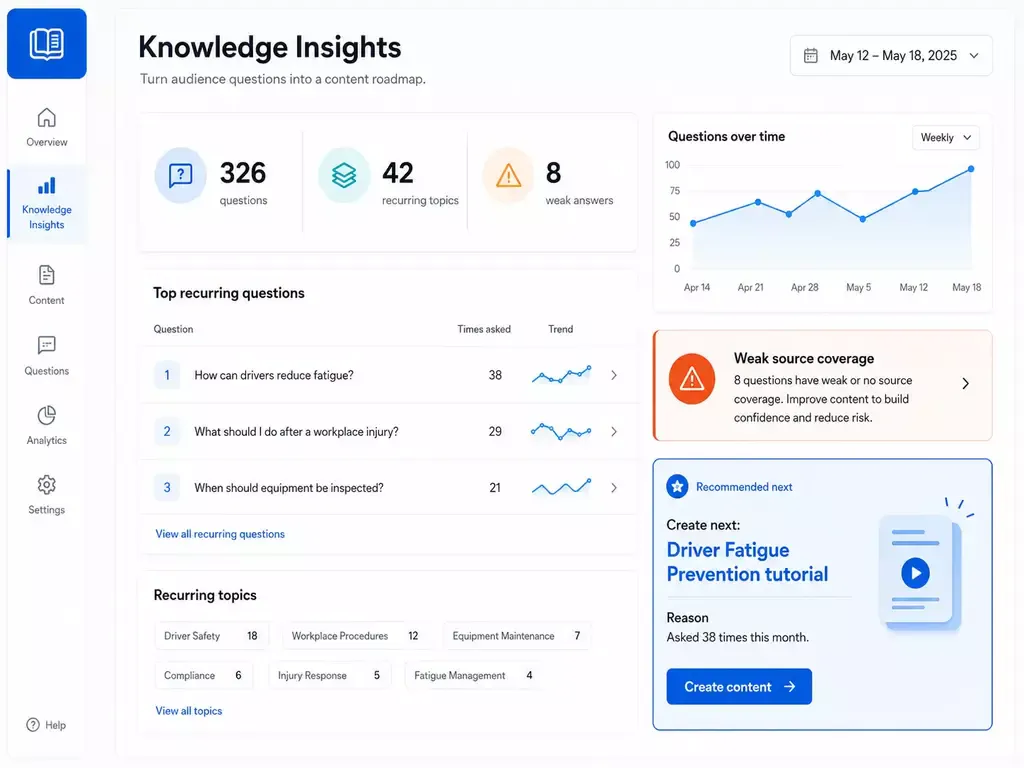
With VideoGPT Insights and Q&A analytics, this history can become an operational signal for improving the knowledge library.

VideoGPT knowledge insights dashboard showing question history, recurring needs, and content gaps
Question history becomes useful when teams can identify recurring needs, weak answers, and gaps across the knowledge environment.

Turn Real Questions Into Knowledge Gap Analysis

History is the evidence; improvement is the goal

A long chat log by itself does not improve a knowledge base. The system should group interaction patterns into decisions. Useful signals include:

  • Questions asked repeatedly by different users
  • Questions that produce weak, incomplete, or uncertain answers
  • Topics that require several follow-up questions
  • Requests for which no approved source exists
  • Videos that repeatedly generate confusion around the same step
  • Policies, screenshots, or procedures that appear to be outdated

These signals create a practical loop: publish existing videos and documents, let people ask, identify gaps, then improve or create the next content.

The Video Knowledge Base Loop explains why teams can publish first and use real demand to decide where better structure, metadata, documents, or new recordings are most valuable.

Where a Private Ask YouTube Alternative Fits

Customer support and troubleshooting

For customer support and troubleshooting, customers can ask a problem in their own words, receive an answer from approved videos and PDFs, and jump to the exact demonstration before opening a ticket. The same knowledge environment can also support agents when they need an approved answer source.

Internal training and process knowledge

For internal training and process knowledge, employees can search software training, workshops, SOP videos, release briefings, and internal documents without knowing which recording contains the answer. Permissions can keep internal collections separate from customer-facing content.

Product education and customer onboarding

For product education and customer onboarding, customers can ask across onboarding videos, feature walkthroughs, update recordings, and product documentation. Question patterns show where education remains unclear even when the content already exists.

Partner and channel enablement

For partner and channel enablement, distributors and partners can use a controlled portal for current product, process, and sales-enablement knowledge while the organization learns which topics repeatedly block the channel.

Large or long-running knowledge collections

The need is not limited to a certain number of videos. Even a small collection can be difficult when the material is dense. As collections grow, a library-level question layer becomes increasingly valuable. See the Leidos customer story for an example of a long-running video and document knowledge deployment.

How to Build a Private Ask YouTube-Style Experience

  • Choose one audience and one measurable problem. Start with repeated support questions, internal software training, customer onboarding, product education, or partner enablement.
  • Select the approved library. Begin with videos and documents that already answer common questions.
  • Define identity and permissions. Decide who can enter and which collections each user group may access.
  • Prepare the sources. Confirm that transcripts, titles, descriptions, chapters, metadata, and supporting PDFs are accurate enough to retrieve.
  • Define answer behavior. Set the permitted knowledge scope, response style, source requirements, and fallback when evidence is insufficient.
  • Deploy where the audience already works. Use an embedded knowledge experience, help center, controlled Page, or private portal.
  • Review questions and improve from demand. Use repeated topics, weak responses, and unanswered needs to update or create the next content.

This publish-first approach activates the library teams already have while creating a practical path toward better structure and governance.

How Cincopa Provides the Private Knowledge Layer

Video hosting remains the foundation

Cincopa provides the hosting, player, delivery, captions, analytics, embeds, and access foundation. Teams can organize approved videos and supporting documents through Galleries, hosted Pages, or Tube portal environments.

The knowledge layer is optional. Organizations that need AI video question answering can enable VideoGPT on the selected collection rather than turning every hosted video into a chat experience.

VideoGPT makes the selected collection answerable

VideoGPT can use video transcripts, chapters, titles, descriptions, tags, and supporting PDFs to answer across the approved environment. It can return grounded answers and link viewers to the relevant moment or document.

VideoGPT Insights then helps authorized teams review questions, answers, sessions, recurring patterns, and weak or missing knowledge. That is the important difference between adding an Ask button and operating a video knowledge system.

Choose the publishing surface that matches the audience

Use a Gallery when the experience belongs inside an existing website, LMS, help center, or intranet. Use a hosted Page for a focused knowledge collection. Use Tube when the audience needs a portal with channels, navigation, and controlled access.

The AI question experience should follow the approved knowledge into the place where employees, customers, or partners already need it.

Frequently Asked Questions

Can Ask YouTube search my company's private video library?

YouTube's published documentation describes consumer experiences built around YouTube content and, for conversational search, web information. It does not document a way for an organization to define a governed private collection of company videos and PDFs with organization-managed permissions and Q&A analytics.

Is an unlisted YouTube video the same as a private knowledge system?

No. Link visibility is only one part of the requirement. An organizational system also needs identity, user groups, permissions, approved source scope, administrative oversight, retention decisions, and insight into what users ask.

Can administrators see what users ask?

That depends on the platform. YouTube documents controls for an individual user's activity, but it does not currently document a creator-facing organizational Q&A dashboard. Cincopa VideoGPT Insights is designed to give authorized teams visibility into questions, answers, sessions, and recurring patterns.

Can AI answer across private videos and PDFs together?

Yes, when the video knowledge platform supports both source types. A useful system can combine transcripts, chapters, and metadata from videos with approved supporting PDFs. This matters when the demonstration is visual but the detailed policy or specification lives in a document.

Does Ask YouTube work inside an embedded player?

Ask YouTube is not listed as a supported YouTube iframe player parameter or IFrame Player API method. A website owner therefore cannot enable or configure it through standard YouTube embed code.

For the related player-control instructions, see how to embed YouTube videos without showing controls.

How should an organization evaluate privacy?

Review authentication, user and group permissions, content-level access, approved source scope, data retention, administrative visibility, export options, vendor data-processing terms, and any industry-specific requirements. Do not treat the word "private" as a substitute for a defined governance model.

How can answer quality improve over time?

Keep transcripts and documents current, limit answers to approved sources, link responses to their evidence, collect feedback, review weak or unresolved questions, and add missing knowledge based on recurring demand.

NEXT STEP

Turn Private Videos Into an Answerable Knowledge Library

Start with one approved video and document collection. Give the right audience a place to ask, verify the source, and show your team what knowledge should improve next.