Knowledge Management Explained: Processes, Systems, and Examples
Every organization creates knowledge through projects, meetings, documents, videos, customer conversations and employee experience.
The challenge is making that knowledge easy to find, trust and reuse.
Knowledge management provides a structured way to capture important information, organize it around user needs and keep it useful over time.
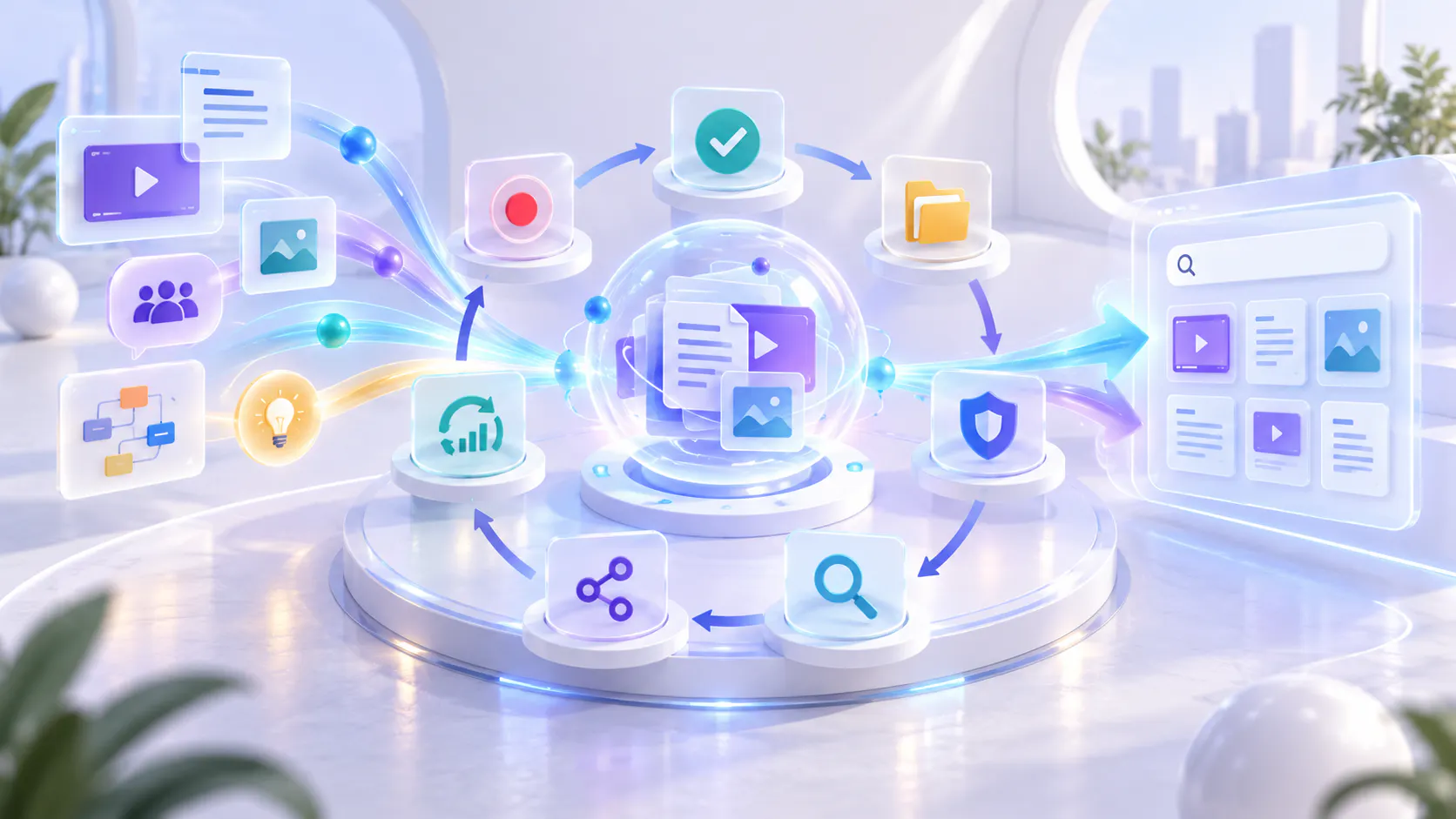
What is knowledge management?
Knowledge management is the process of capturing, reviewing, organizing, governing, retrieving, sharing and improving an organization’s knowledge.
Its purpose is to help employees, customers and partners find reliable answers without repeatedly asking the same experts or recreating existing work.
A knowledge management system can include:
Documents and help articles
Videos and screen recordings
Standard operating procedures
Training materials
Meeting notes
Policies and reference files
Search tools
Knowledge bases
Learning portals
AI-assisted answer tools
Technology supports knowledge management, but it is only one part of the system. Useful knowledge also requires clear ownership, accurate sources and regular review.
Why knowledge management matters
Important knowledge is often scattered across departments and tools.
One employee may know how to solve a recurring technical problem. A customer-success manager may explain the same workflow every week. A product team may have useful demonstrations stored inside old meeting recordings.
When this knowledge is not managed, teams can experience:
Repeated questions
Inconsistent answers
Slower onboarding
Duplicated work
Outdated instructions
Dependence on individual experts
Loss of knowledge when employees leave
Difficulty finding trusted information
Knowledge management helps turn individual experience and scattered content into a shared organizational resource.
The goal is not to store everything. It is to make important knowledge available to the people who need it.
Information is not automatically knowledge
An organization can have thousands of files and still struggle to answer basic questions.
A shared drive is not necessarily a useful knowledge system. A video library is not useful if titles are unclear. Complete documentation can still fail when users do not know where to look.
Information becomes usable knowledge when people can:
1. Find it.
2. Understand it.
3. Trust it.
4. Apply it.
5. Return to it when needed.
This means knowledge management should focus on usefulness, not content volume alone.
The knowledge management process
A practical knowledge management process has seven connected stages.
1. Capture
Record important knowledge in a reusable format.
This may involve writing a document, recording a demonstration, documenting a decision or saving a troubleshooting solution.
Capture should be simple. If the process is too difficult, valuable knowledge may remain inside private conversations or individual experience.
2. Review
Check whether the captured information is accurate, complete and appropriate for its audience.
Review should also identify outdated guidance, confidential information and conflicts with existing sources.
3. Organize
Group knowledge according to how people use it.
Useful structures may include:
Role
Product
Feature
Workflow
Department
Customer journey
Release
Problem type
The same approved source may support more than one audience. A permissions walkthrough, for example, could help new users, administrators and support teams.
4. Govern
Define who owns the knowledge and how it will be maintained.
Governance can include:
Content owners
Approval requirements
Access permissions
Review dates
Version labels
Update triggers
Archive rules
Governance should protect quality without making contribution unnecessarily difficult.
5. Retrieve
Give users practical ways to find the right information.
Retrieval may use navigation, categories, filters, keyword search, transcripts, metadata, internal links or AI-assisted questions.
Recorded knowledge requires particular attention. Users should be able to reach the relevant part of a video without watching the entire recording.
Cincopa supports this use case as a Video Knowledge Platform. It helps teams organize videos and supporting documents into structured knowledge experiences and lets users retrieve answers from available sources. This is useful when important knowledge lives inside product demonstrations, training sessions, meetings or recorded workflows.
6. Share and reuse
Make approved knowledge available across the places where people work.
A product walkthrough might appear in a help center, onboarding program, customer portal and support response. Reusing the same source reduces duplicated work and keeps guidance consistent.
7. Improve
Review how people use the system.
Repeated questions, unsuccessful searches, weak answers and outdated sources can reveal where improvements are needed.
These patterns are signals, not automatic proof that new content is required. The real problem may be poor organization, unclear wording, product friction or missing access.
Types of organizational knowledge
Knowledge generally appears in three forms.
Explicit knowledge
Explicit knowledge has already been recorded.
Examples include policies, help articles, manuals, videos, checklists and standard operating procedures.
It is usually the easiest type to store and share.
Tacit knowledge
Tacit knowledge comes from personal experience and judgement.
An experienced employee may know how to handle unusual situations or recognize the early signs of a problem. This knowledge can be difficult to document because experts may not realize which parts of their experience are valuable.
Interviews, mentoring and recorded explanations can help make tacit knowledge more accessible.
Implicit knowledge
Implicit knowledge has not been documented but could be explained.
For example, an employee may complete the same process every week without having written down the steps. A demonstration can turn that experience into a reusable resource.
Written, recorded and hybrid knowledge systems
Organizations do not need to use only one format.
Written knowledge
Written knowledge includes documentation, policies, articles, checklists and reference guides.
It works well for:
Precise instructions
Definitions
Policies
Code examples
Information that changes frequently
Content users need to scan or copy
Written content can be updated quickly, but visual workflows may be difficult to explain with text alone.
Recorded knowledge
Recorded knowledge includes videos, screen recordings, webinars and meeting recordings.
It works well for:
Product demonstrations
Visual procedures
Expert explanations
Training
Troubleshooting
Complex workflows
Video preserves visual context and the sequence of a task. However, users may struggle to find one answer inside a long recording unless transcripts, metadata or search tools are available.
Hybrid knowledge
A hybrid system combines written and recorded resources.
For example, a product workflow could include a short demonstration video, written steps, a checklist and a troubleshooting guide. This gives users more than one way to learn and provides both visual explanation and precise reference information.
Cincopa can support this hybrid approach by keeping videos, transcripts, PDFs and supporting documents connected within the same knowledge environment. However, it does not replace every documentation, learning or collaboration system. It can work alongside the tools an organization already uses.
Common knowledge management systems
Different systems support different knowledge jobs.
Document repositories
These store files and provide folders, permissions and collaboration. They are useful for storage but can become difficult to navigate as content grows.
Internal knowledge bases
These contain company policies, processes, project information and employee guidance.
Customer help centers
These provide documentation, FAQs and troubleshooting information for customers.
Learning management systems
These organize courses, assessments, learner progress and completion records. They are useful for formal training but may be too structured for everyday answer retrieval.
Video knowledge systems
Video knowledge systems organize videos, transcripts and supporting documents for browsing, search and reuse.
Cincopa is an example of this category. Its Galleries, Pages, Tube environments and VideoGPT capabilities help organizations structure, publish and retrieve knowledge from videos and related documents.
This type of system is useful when recorded demonstrations, meetings, training sessions and expert explanations have become important organizational resources rather than temporary media files.
Search and AI-answer systems
These help users retrieve information across connected sources. They can improve access, but they do not replace content ownership or source review.
Practical knowledge management examples
Employee onboarding
A company organizes policies, team introductions, system walkthroughs and process guides in one onboarding environment.
New employees can find basic information without relying on repeated live explanations.
Customer support
A support team converts recurring solutions into approved articles and troubleshooting videos.
Customers can solve common problems independently, while support agents can reuse trusted explanations.
Product education
A software company organizes onboarding videos, feature walkthroughs, release updates and supporting documents by role and workflow.
Customers can return to the material whenever they need help completing a task.
Preserving employee knowledge
Before an experienced employee leaves, the organization should identify important responsibilities, decisions and process exceptions.
The employee can record demonstrations and explanations while the team reviews and updates the related documentation.
Cincopa’s Internal Knowledge Base Software approach can help teams organize internal videos, documents, process knowledge and recorded expertise in a controlled knowledge environment. Access, ownership and source review should still be managed according to the organization’s governance requirements.
How Cincopa fits into knowledge management
Cincopa supports the recorded and hybrid parts of a broader knowledge management strategy.
Organizations often have important knowledge inside product walkthroughs, training sessions, webinars, support demonstrations, meetings and internal explanations. Cincopa helps teams organize these recordings with supporting documents and publish them through Galleries, Pages or portal-style Tube environments.
VideoGPT can provide an answer layer across available videos and documents, helping users move from a question to the relevant source or video moment. Questions and weak-answer signals can then help teams identify material that may need clarification, better organization or further review.
This does not mean Cincopa replaces every knowledge management tool. Written documentation platforms may remain the best source for detailed policies, technical references and frequently updated instructions. Learning management systems may still be needed for formal courses, assessments and certifications.
Cincopa is most relevant when video has become an important source of reusable knowledge that needs structure, controlled delivery, retrieval and supporting context.
Common knowledge management challenges
Knowledge is scattered
Information is spread across email, messaging tools, shared drives, meeting recordings and individual platforms.
Start by identifying the most valuable sources. Do not attempt to migrate everything immediately.
Content cannot be trusted
Several versions exist, or no one knows which source is current.
Assign an owner, approval status, version label and review date to important resources.
Users cannot find answers
The information exists, but its title, location or terminology does not match the user’s question.
Improve navigation, descriptions, metadata, transcripts and internal links before creating more content.
Experts do not document their work
Traditional documentation may feel too slow for busy subject-matter experts.
Allow experts to record demonstrations or explanations, then review and organize the material.
The library becomes outdated
Content is published but never reviewed.
Connect reviews to product releases, policy changes, system updates and repeated user questions.
How to build and improve a knowledge management system
Start with one important problem instead of trying to organize the entire company.
Step 1: Define the problem
Choose a specific issue, such as repeated onboarding, hard-to-find support answers or the loss of employee expertise.
Step 2: Identify the audience
Define who needs the knowledge and what they are trying to accomplish.
Step 3: Review existing sources
Find the documents, videos, notes and other materials that already address the problem.
Step 4: Select approved knowledge
Remove duplicates, resolve conflicts and confirm which sources are accurate.
Step 5: Organize around user needs
Group the approved sources by role, workflow, task or problem.
Step 6: Make retrieval practical
Use clear titles, descriptions, metadata, transcripts, navigation and search.
Step 7: Assign ownership
Identify who will approve, update and retire each important resource.
Step 8: Learn from real use
Review questions, searches, engagement and feedback.
Step 9: Improve gradually
Update the system based on verified problems instead of assumptions.
The Video Knowledge Base Loop follows a similar approach: publish useful knowledge, make it answerable, learn from real questions and improve it over time.
How to measure knowledge management
The right measurements depend on the purpose of the system.
Useful indicators may include:
Time required to find an answer
Successful searches
Repeated questions
Use of approved sources
Content reuse
Outdated-content rate
Support-ticket patterns
Onboarding time
User feedback
Task completion
Avoid relying only on page views or video views. High traffic does not automatically mean users found the information helpful.
Measurement should help teams decide what to improve next.
Build a continuous knowledge system
Knowledge management is not a one-time documentation project.
Products change. Employees move between roles. Policies are updated. Customers ask new questions and old guidance becomes inaccurate.
Cincopa’s Video Knowledge Base Loop provides one practical model for recorded knowledge: capture expertise, publish approved videos and documents, let users ask questions, learn from recurring needs and improve the library over time.
A broader knowledge management program can follow the same continuous cycle:
1. Capture valuable knowledge.
2. Review and approve it.
3. Organize it around user needs.
4. Make it easy to retrieve.
5. Share and reuse it.
6. Learn from real usage.
7. Improve the system.
The objective is not to preserve every piece of information. It is to make important knowledge trusted, findable and useful.
Whether that knowledge is written, recorded or combined, people should be able to reach it and apply it with confidence.