SUPPORT KNOWLEDGE

Known Issue, Workaround, or Fix? How to Structure Support Content During an Active Incident

Separate incident status, temporary task guidance and a verified fix. Keep the videos and documents customers use connected to clear owners, review points and next steps.

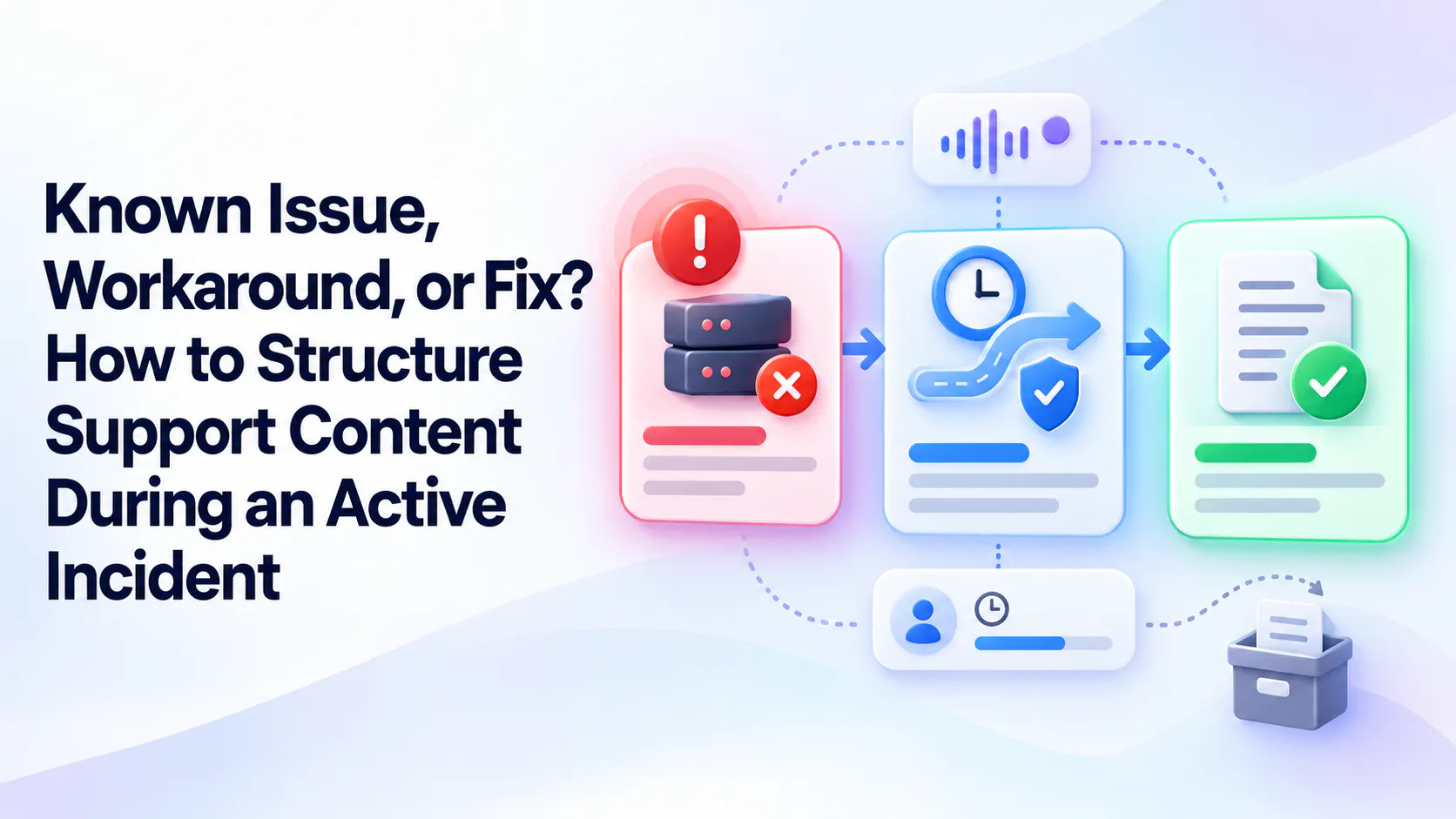
Known Issue, Workaround, or Fix? Illustration of incident support guidance, a temporary workaround, and verified resolution.

“We know about it” does not tell customers what to do

A hypothetical reporting service delays exports. Customers press Export again and ask whether their report disappeared. The status page acknowledges a delay but does not answer the practical question: wait, use an approved alternative or contact support?

Useful incident guidance connects the known scope to a clear next step. When no workaround has been approved, say so instead of filling the notice with speculative actions.

Distinguish a known issue, workaround, and verified fix

A known issue is an acknowledged problem with a stated scope. A workaround is an approved temporary way to reduce its impact or complete a task. A fix is a corrective change whose effectiveness has been verified for the stated situation.

Keep those labels distinct. A suspected cause is still a hypothesis, and deploying a change starts verification rather than proving recovery. State what is confirmed, what remains uncertain and which users or product states the guidance covers.

Give each information layer a clear job

Give availability updates, detailed task guidance and lasting knowledge distinct responsibilities, even when one tool presents them all. This prevents a support article from competing with the incident timeline.

A post-incident review can explain causes and response decisions for its audience. Keep current user instructions in the maintained support source. Use the table below to distinguish these information layers and the people responsible for them.

Layer
Main customer question
Information
Links to
Status page
Is the service available?
Affected components, incident progress, next update timing.
Known-issue task guidance.
Known-issue hub
What can I do now?
Scope, approved actions or none, verification, escalation.
Authoritative status; lasting guidance when ready.
Permanent knowledge
How should this work now?
Durable verified procedure, confirmed fix or continuing limitation.
Relevant historical incident and current support guidance.
Status page
Main customer question
Is the service available?
Information
Affected components, incident progress, next update timing.
Links to
Known-issue task guidance.
Known-issue hub
Main customer question
What can I do now?
Information
Scope, approved actions or none, verification, escalation.
Links to
Authoritative status; lasting guidance when ready.
Permanent knowledge
Main customer question
How should this work now?
Information
Durable verified procedure, confirmed fix or continuing limitation.
Links to
Relevant historical incident and current support guidance.

Build known-issue guidance around affected user tasks

Lead with the observable symptom and affected task, followed by the relevant feature, versions or configurations, confirmed impact and exclusions. Do not imply that every similar symptom belongs to the incident.

Link to the authoritative incident status, show when the guidance was last verified and name its next review point. For the fictional export delay, explain which work is affected, what remains available and the approved contact conditions. Acknowledge unknown scope explicitly.

Present a workaround with prerequisites, limits, and verification

An approved workaround needs prerequisites, one bounded procedure, limitations, expected results and a way to verify them. Put warnings and stop conditions before the affected action.

For the fictional export case, an alternative format would qualify only after its availability and data coverage were checked for affected users. Do not encourage repeated submissions or consequential changes without a validated procedure. If the result differs, explain when to stop and how to escalate rather than extending the workaround by guesswork.

Use visual guidance when the action is difficult to explain

Use a short recording or annotated screenshot when the action depends on finding an unfamiliar control or recognizing a product state. Retain the scope, warnings and essential steps in scannable written form.

Cincopa can publish a focused collection of reviewed recordings and supporting documents. VideoGPT can answer from the content made available to that collection and link to its sources. Keep incident detection, technical approval and retirement decisions in their responsible workflows; publishing a collection does not validate or automatically expire a workaround.

Assign an owner and review trigger to every temporary answer

Assign a content owner and technical approver, and record the incident reference, verification time and next review point. Arrange coverage so an unavailable author does not delay an urgent correction.

Review when scope changes, a workaround fails, a product state changes or recovery is reported. Revalidate overdue guidance or visibly change its status and withdraw unchecked steps as appropriate. A deadline needs an accountable action, not just a reminder.

Keep channels consistent without creating competing sources

Use ticket replies, chat, in-app notices and agent notes to provide context and link to authoritative guidance. Copying detailed steps into every channel creates competing versions that can survive a correction.

Keep customer actions in the appropriate public or customer-facing source and restricted operational details in internal records. Check mobile access and fallback contact routes before an incident. If the application is unavailable, an in-app notice alone may not reach affected users.

Verify recovery and retire temporary instructions deliberately

Service recovery, completion of delayed work and resolution of a customer's original problem are separate checks. A healthy export service does not establish that a queued report has arrived.

After verified recovery, decide whether the workaround should be withdrawn, retained for a continuing limitation or reversed through approved instructions. Update the enduring answer and its incoming links. Review recurring questions and weak VideoGPT answers for missed explanations, then improve the source collection. Create a new permanent article only when a distinct lasting need remains.

If temporary guidance includes a recording of an older interface, follow the walkthrough maintenance process so the verified fix and the demonstration remain consistent.

Use a reusable temporary-guidance template

Use the template below for temporary guidance. Fill unknowns explicitly and link to the maintained incident timeline instead of duplicating it. The completed example is fictional and illustrates the content structure, not a real incident notice or a validated customer procedure.

Temporary-guidance authoring fields

Known-issue title: [affected task and symptom].

Incident or issue reference: [identifier].

Current guidance status: [under review / current / superseded / resolved].

Symptom and affected task: [observable problem].

Confirmed applicability and exclusions: [scope; unresolved questions].

Approved workaround: [approved procedure, or none available].

Prerequisites and warnings: [permissions, preparation, limits].

Expected result and verification: [observable outcome and check].

Stop and escalation conditions: [when to stop; approved contact route].

Authoritative status link: [maintained incident destination].

Content owner and technical approver: [named people or accountable roles].

Last verified time and next review deadline: [date, time, timezone for each].

Withdrawal or replacement condition: [trigger and responsible owner].

Written and visual references: [current supporting materials].

Hypothetical delayed-report example

Illustrative completed example — fictional service; not a real notice or validated product procedure.

Title: Delayed report exports. Reference: EXAMPLE-17. Guidance status: example only. Symptom/task: a submitted export has not arrived. Scope: the fictional reporting environment; other environments unconfirmed. Workaround: none approved. Prerequisites/warnings: no customer procedure authorized; do not interpret this example as advice to resubmit.

Verification: the technical approver must confirm processing and delivery before claiming recovery. Stop/escalation: unresolved delivery questions go through the service’s approved support route. Status link: insert the real service’s authoritative incident URL before use. Owner: support content lead; approver: reporting service lead.

Last verified: 29 October 2026, 09:00 UTC; next review: 10:00 UTC, illustrative times only. Replace after verified recovery or an approved change in scope. References: maintained written guidance; no recording required while there is no approved visual procedure.

Frequently asked questions

A known issue describes an acknowledged problem and its scope. An incident is an operational event being managed for service impact. An incident may expose several known issues; a known limitation may continue after the incident closes. Link related records without treating their statuses as interchangeable.

Put detailed, maintained task instructions in an accessible support source and link to them from status updates. Keep availability, progress, and update timing on the authoritative status surface. One system can serve both purposes if their responsibilities and ownership remain clear.

Say that no approved workaround is available. Describe confirmed scope, what remains unknown, where updates will appear, and when support should be contacted. Do not pad the notice with speculative steps or promise a resolution time that has not been authorized.

Use event-triggered checks plus an explicit deadline suited to the incident’s pace and risk. Review immediately when scope, instructions, or product state changes. Record the timezone and assign coverage; a missed deadline should lead to revalidation or a visible status change.

Only when a corrective change addresses the underlying problem and its effectiveness has been verified for the stated scope. A successful temporary alternative remains a workaround. Deployment alone does not demonstrate recovery or completion of outstanding customer work.

Review their instructions, embeds, captions, and associated links. Withdraw obsolete clips from active guidance, mark useful historical material clearly, and replace recordings needed for continuing tasks. Retain records according to applicable policies rather than deleting them automatically.

No. Update an existing answer when it covers the enduring need. Create new guidance for a distinct recurring task or continuing limitation. Some incidents require a historical record and cleanup of temporary advice without adding another permanent support article.

Make temporary guidance accountable

Tell customers what is known, what they can appropriately do and where the next update will appear. Keep temporary video and document guidance accountable, then replace or retire it after verification. Reuse valid explanations and improve them from the questions customers still ask.

NEXT STEP

Keep incident guidance connected

Explore how a focused video-and-document collection can make reviewed guidance easier to find, reuse and improve from real support questions.