KNOWLEDGE OPERATIONS

Which Documentation Features Matter Most for a SaaS Team?

Choose documentation features around support, training and developer tasks. When useful answers already live in recordings and PDFs, start by making that knowledge usable.

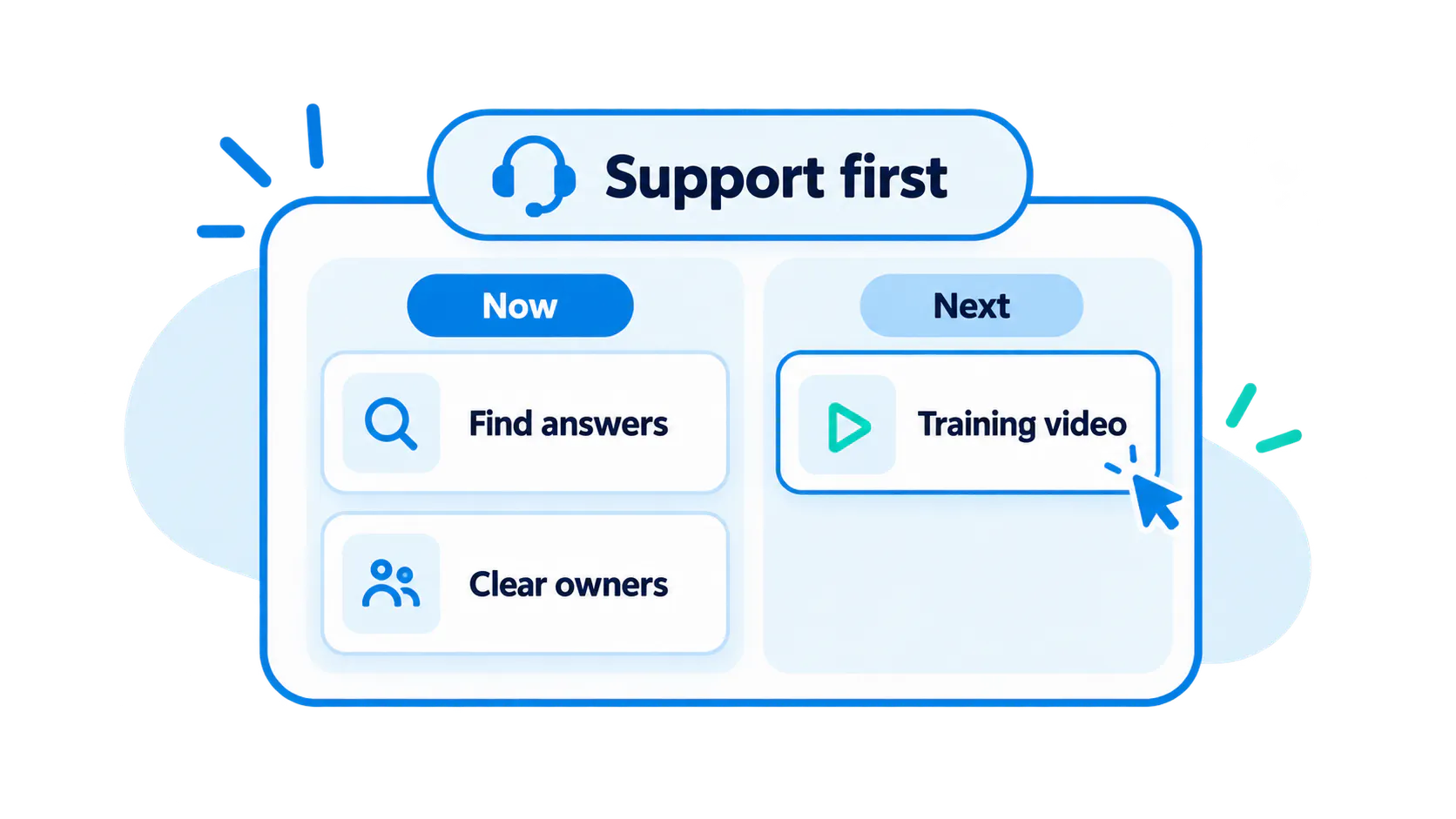
Conceptual support-first requirements board prioritizing find answers and clear owners now, with training video next.

Start with the job your documentation must do

A hypothetical SaaS team selects a documentation tool with an impressive feature list. Yet a new support colleague cannot tell which access instructions apply to their role. More features have not solved the task.

Customer troubleshooting, employee learning, API integration and controlled delivery need different capabilities. Start with the audience's work and the content you already have. One organization may reasonably use several connected systems with clear ownership rather than force every knowledge need into one tool.

Establish the foundations every team needs

Every team needs accurate guidance, understandable navigation, usable search, named owners, accessible presentation and a practical updating process. Verify these outcomes with real tasks instead of checking labels on a vendor page.

Test the author's experience too: revising guidance, requesting review, recovering a previous version and maintaining links. Clear task titles or contextual links may solve a discovery problem before advanced search is necessary. No retrieval system can make an ambiguous or obsolete procedure authoritative.

For customer support, prioritize finding and applying the answer

Prioritize symptom-based discovery, recognizable titles, relevant search results, feedback and contextual help near the point of confusion. Use localization when the audience needs it, and look for evidence of unresolved searches rather than page views alone.

A screenshot can identify a control, a short video can explain a sequence and a source-linked answer can make evidence easy to inspect. Test whether an unfamiliar reader selects the applicable version, completes the steps, recognizes success and knows where to go if the procedure fails.

For internal training, prioritize access, context, and reusable explanations

Employees need explanations organized around their role and work, with appropriate access and ownership. When knowledge already exists in recordings, evaluate how they reach the useful moment and its supporting reference.

Cincopa's Video Knowledge Platform lets teams publish an existing video-and-document collection and make it answerable with VideoGPT. This can complement written documentation without a complete rebuild. A knowledge reference library is distinct from assigning courses, assessing learners or maintaining formal completion records; evaluate an LMS separately when those are requirements.

Explore how supporting documents can sit alongside video, then test whether that arrangement helps employees complete a specific task.

For developer documentation, prioritize technical accuracy and version control

Developer documentation may require API references, working code examples, version-specific guidance and an engineering review process. Test whether readers can identify the API version and prerequisites, authenticate, complete an operation and recover from a documented error.

OpenAPI generation, interactive explorers and docs-as-code are useful when they fit the authors and maintenance process. A valid schema does not necessarily explain the integration journey. Keep specialist documentation in the workflow that can maintain it reliably, with clear links from the customer's starting point.

For regulated delivery, prioritize controlled access and evidence

Define approval, access, revision, retention and evidence requirements with the responsible stakeholders. Then test the actual review and delivery workflow rather than assuming a feature name establishes compliance.

Viewing activity is not automatically understanding or formal acknowledgment. Revision history is not necessarily an approval trail. If identity-linked acknowledgment or controlled records are required, specify what must be captured, who can access it and how it can be retrieved before evaluating the tools.

Compare features by need, not by how impressive they sound

Classify features as core, conditional or secondary for the current use case. Video can be central to an explanation library but unnecessary for a small error-code reference. Versioned content may become essential when customers run different API releases.

Use the matrix below as a starting hypothesis, not a universal buying rule. Record the task or condition that makes each capability necessary, then test it with your audience and representative content.

Capability
Customer support
Internal training
Developer docs
Regulated delivery
Search and discovery
Core
Core
Core
Core
Product-version selection
Conditional
Conditional
Core
Conditional
Permissions
Conditional
Core
Conditional
Core
Video and supporting files
Conditional
Conditional
Usually secondary
Conditional
Review workflows
Core
Core
Core
Core
API-specific tooling
Usually secondary
Usually secondary
Conditional
Usually secondary
Audit and approval evidence
Conditional
Conditional
Conditional
Core
Search and discovery
Customer support
Core
Internal training
Core
Developer docs
Core
Regulated delivery
Core
Product-version selection
Customer support
Conditional
Internal training
Conditional
Developer docs
Core
Regulated delivery
Conditional
Permissions
Customer support
Conditional
Internal training
Core
Developer docs
Conditional
Regulated delivery
Core
Video and supporting files
Customer support
Conditional
Internal training
Conditional
Developer docs
Usually secondary
Regulated delivery
Conditional
Review workflows
Customer support
Core
Internal training
Core
Developer docs
Core
Regulated delivery
Core
API-specific tooling
Customer support
Usually secondary
Internal training
Usually secondary
Developer docs
Conditional
Regulated delivery
Usually secondary
Audit and approval evidence
Customer support
Conditional
Internal training
Conditional
Developer docs
Conditional
Regulated delivery
Core

Evaluate AI answers against the source content

Evaluate AI where it helps users retrieve and apply supported knowledge. Test source links, missing answers, freshness and access boundaries, including questions the collection cannot answer and sources that disagree.

For a video-and-document library, ask VideoGPT a real question and inspect the referenced material. Then review recurring questions and weak answers to decide which source needs improvement. Start by activating a useful existing collection; let observed gaps guide the next content, rather than assuming AI organizes or updates every external system.

Distinguish a knowledge answer from a live system lookup when evaluating account-specific requests, because a source-based explanation does not establish the current state of a billing or operational system.

Separate launch essentials from later improvements

Separate launch requirements from useful later improvements. Tie each required capability to an observable task outcome and include authoring effort, maintenance, accessibility, integrations and export in the decision.

The hypothetical team might solve repeated support questions first while keeping API references in its engineering workflow. More included features can still create duplicate work. Choose the smallest maintainable setup that supports the current audience, with a clear expansion path.

Priority
Hypothetical team's decision
Reason
Required now
Support search, task navigation, owners, feedback
Resolve recurring customer troubleshooting tasks.
Useful next
Searchable recordings and localized guidance
Add when audience needs justify maintenance effort.
Keep existing
Engineering's developer-docs workflow
Avoid disrupting versioned technical authoring.
Outside current scope
Formal learning assignments
No current completion-record requirement.
Required now
Hypothetical team's decision
Support search, task navigation, owners, feedback
Reason
Resolve recurring customer troubleshooting tasks.
Useful next
Hypothetical team's decision
Searchable recordings and localized guidance
Reason
Add when audience needs justify maintenance effort.
Keep existing
Hypothetical team's decision
Engineering's developer-docs workflow
Reason
Avoid disrupting versioned technical authoring.
Outside current scope
Hypothetical team's decision
Formal learning assignments
Reason
No current completion-record requirement.

Test shortlisted tools with real tasks

Test shortlisted tools with imperfect articles, a restricted procedure, an outdated screenshot and a recording when visual knowledge matters. Define success before the evaluation.

Have an author update changed guidance, a reviewer check it and a reader complete the task. Test denied access with the intended role and try an export or recovery. Record failures and workarounds as well as successful demonstrations. Choose a workflow your team can sustain after launch.

Frequently asked questions

Start with accurate guidance, clear task navigation, usable search, ownership, and simple updates. Add capabilities when a real audience or workflow requires them, rather than copying an enterprise feature list.

No. Clear titles and dependable navigation may solve the immediate problem. Evaluate AI when it improves representative tasks and handles sources, missing answers, freshness, and permissions appropriately.

Sometimes, but test each workflow separately. Connected specialist systems can be a better fit when authoring, access, learning records, or versioning requirements differ substantially.

It matters when demonstrations or recorded expertise explain tasks more effectively than text alone. Evaluate discovery, accessibility, supporting materials, and the effort required to keep recordings current.

Revision history tracks edits to a resource. Product versioning helps readers select guidance for the release they use. Keeping old edits does not automatically provide a usable version-specific documentation experience.

Start with the organization’s defined approval, access, revision, retention, and evidence requirements. Validate those workflows with responsible stakeholders; analytics alone may not satisfy the required evidence.

Run realistic find-and-use, authoring, permission, and recovery tests with intended users and representative content. Compare observable results, maintenance effort, and unresolved requirements rather than feature counts.

A practical takeaway

Choose features that help readers finish their work and help owners maintain reliable sources. If valuable knowledge already exists in videos and documents, start with one focused, answerable collection and improve it from real questions. Add complexity when it solves a demonstrated need.

NEXT STEP

Start with the knowledge you already have

Bring a recurring question and a small set of existing videos or documents. See how VideoGPT can help your audience reach the relevant answer.