SUPPORT KNOWLEDGE

Knowledge Answer or Live System Lookup? What Support AI Can Resolve From Documentation

A how-to answer, a current account lookup and an account change need different evidence. Learn where video-and-document knowledge helps and when another system or person is needed.

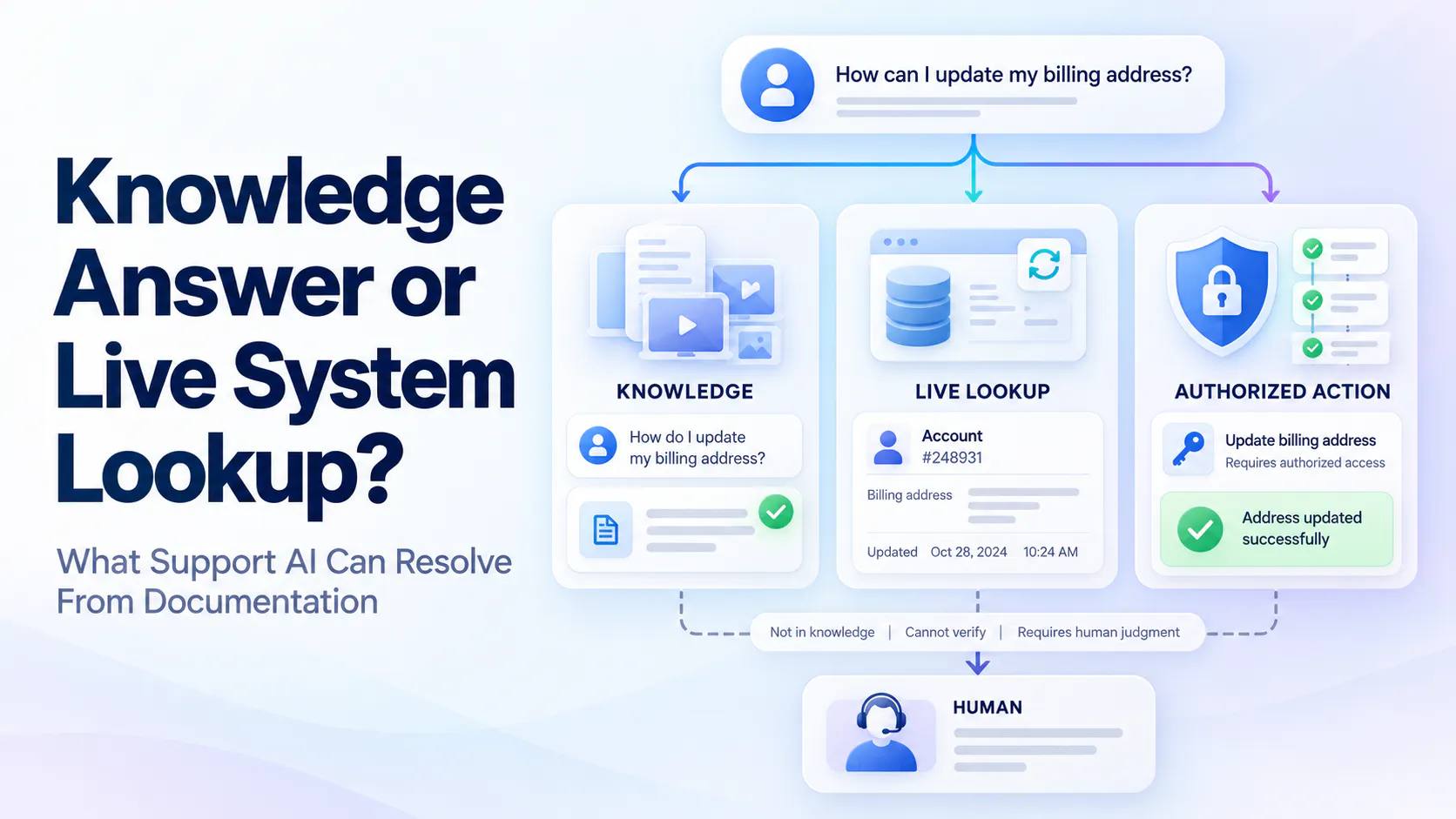
Knowledge Answer or Live System Lookup? Conceptual illustration distinguishing knowledge, live lookup, authorized action, and human support.

“How do I check my subscription?” and “Why was my subscription suspended?” are different questions

“Where do I check my subscription?” asks for a documented procedure. “Why was my subscription suspended this morning?” asks for evidence about a particular account. The same guide cannot establish both answers.

In this hypothetical example, the first question can be answered from the applicable instructions. The second needs an authorized account lookup and possibly human review. A list of possible suspension reasons is not an explanation of what happened to this customer.

What the knowledge layer can answer

The knowledge layer explains procedures, prerequisites, configuration options, known error meanings and published policies. It can retrieve the relevant guidance and show where an explanation came from.

Match the source to the product version, audience and configuration. A documented error may have several causes; the source can explain approved checks without proving a diagnosis in the customer's environment. Source links help the reader inspect the evidence, but an obsolete or incomplete source still needs correction.

The guide to grounded AI product knowledge explains how approved sources, applicability and review support this kind of answer.

What requires a live system lookup

Order progress, current subscription status, entitlements, device telemetry and operational records belong to systems that maintain those facts. Documentation can explain a status label; it cannot establish a particular record's state today.

Check the observation timestamp, synchronization delay, cache age and source availability. A successful request can still return old information. State which record was checked and when. Do not turn a reported status into a causal explanation unless the operational evidence supports it.

Use a decision table to route the question

Classify the evidence required rather than the keywords in the question. “Subscription” might introduce a navigation question, a current-state lookup or a cancellation request. Use the decision matrix to choose the appropriate source and workflow.

Example question
Evidence required
Appropriate route
Boundary or next step
How do I download an invoice?
Applicable billing guide and role requirements.
Knowledge layer.
Explain navigation; retrieving a specific invoice needs authorized access.
Has my order shipped?
Current authorized order and fulfillment record.
Live lookup.
Report observed state and timestamp; do not infer delivery.
Why does this documented error appear?
Version-specific error reference.
Knowledge layer.
Explain possible causes; confirm this occurrence only with further evidence.
Is my device currently offline?
Authorized telemetry and last observation.
Live lookup.
Distinguish last reported state from current certainty.
My plan includes this feature; why can’t I access it?
Guidance, entitlement, role, configuration.
Mixed question.
Combine supported sources or escalate disagreement.
Can you cancel my subscription?
Identity, authority, policy, supported operation.
Authorized action workflow.
A lookup cannot cancel; obtain required confirmation and verify outcome.
Should I bypass this protection to clear an unknown fault?
Approved scope and qualified technical judgment.
Human escalation.
Do not improvise consequential troubleshooting.
How do I download an invoice?
Evidence required
Applicable billing guide and role requirements.
Appropriate route
Knowledge layer.
Boundary or next step
Explain navigation; retrieving a specific invoice needs authorized access.
Has my order shipped?
Evidence required
Current authorized order and fulfillment record.
Appropriate route
Live lookup.
Boundary or next step
Report observed state and timestamp; do not infer delivery.
Why does this documented error appear?
Evidence required
Version-specific error reference.
Appropriate route
Knowledge layer.
Boundary or next step
Explain possible causes; confirm this occurrence only with further evidence.
Is my device currently offline?
Evidence required
Authorized telemetry and last observation.
Appropriate route
Live lookup.
Boundary or next step
Distinguish last reported state from current certainty.
My plan includes this feature; why can’t I access it?
Evidence required
Guidance, entitlement, role, configuration.
Appropriate route
Mixed question.
Boundary or next step
Combine supported sources or escalate disagreement.
Can you cancel my subscription?
Evidence required
Identity, authority, policy, supported operation.
Appropriate route
Authorized action workflow.
Boundary or next step
A lookup cannot cancel; obtain required confirmation and verify outcome.
Should I bypass this protection to clear an unknown fault?
Evidence required
Approved scope and qualified technical judgment.
Appropriate route
Human escalation.
Boundary or next step
Do not improvise consequential troubleshooting.

Handle mixed questions with both guidance and current context

A customer asks, “My plan includes reports, so why can't I open them?” The documented rules explain which plans and roles allow access; they do not establish this customer's entitlement or role.

Through a supported, authorized integration, check the relevant workspace, entitlement, role and configuration. Retrieve the matching guidance and compare the evidence. If the plan allows reports but the user's role does not, explain that verified restriction and the access-request route. If evidence conflicts, hand off with what was checked. This integration pattern is distinct from Cincopa's knowledge-retrieval role.

Separate reading a record from changing it

Reading a permitted account record is different from refunding a payment, cancelling a subscription or changing permissions. Changes require a specifically supported operation and suitable authorization.

Check the affected record, requester rights and any required confirmation. Report completion only after the action workflow verifies the result; an accepted request may still be pending. A retrieved policy or an assistant's ability to read a record does not, by itself, authorize a consequential change.

Respect identity, permissions, and information boundaries

Authentication establishes identity; authorization determines which sources, records and actions that identity can access. A signed-in employee should not automatically see every customer's data.

Limit retrieval to the relevant information and preserve restrictions on documentation as well as operational records. Use approved sign-in and support channels instead of collecting passwords, API secrets or unnecessary personal details in chat. When access cannot be established, explain the boundary and provide the appropriate route.

Handle missing, stale, or conflicting evidence explicitly

An unavailable integration, stale timestamp, contradictory article or unsupported configuration should change the answer. State what could and could not be verified. A failed lookup is not evidence that an account or device does not exist.

The assistant may still explain the general procedure while making the missing account evidence clear. Ask a focused question when it resolves an ambiguity, and hand off when evidence or authority is missing. Include useful references so the customer does not restart the investigation.

Understand where a video knowledge platform fits

Useful support knowledge already exists in walkthroughs, manuals, recordings and PDFs. Publish a focused collection and make it answerable before planning an extensive documentation rebuild.

Cincopa's VideoGPT can answer across available videos and supporting documents and link to sources. Exact spoken-moment links depend on timestamped transcript data. This knowledge layer complements operational systems; it does not supply live billing records, telemetry or account-change authority. Review recurring questions and unsupported answers to identify which source explanation to improve next.

Test the answer boundary before choosing a support AI tool

Evaluate documentation questions, live-record questions, mixed cases, action requests and questions the sources cannot answer. Include denied access, contradictory guidance and an unavailable integration.

For each case, check evidence, freshness, permission handling and the handoff. Does a possible cause become an unsupported diagnosis? Is a lookup mistaken for authority to act? Measure supported task outcomes rather than generated responses. Use the checklist below alongside a documentation-feature evaluation to test what the team actually needs.

  • Knowledge sources: which formats, versions, and approval states are supported?
  • Integrations: which operational records can actually be read?
  • Freshness: are observation times and lookup failures visible?
  • Permissions: are source and record restrictions preserved?
  • Action controls: which changes are supported, authorized, and confirmed?
  • Evidence: can users inspect the basis for the answer?
  • Handoff: what happens when evidence is absent or contradictory?

Frequently asked questions

Yes, when the question concerns an applicable documented procedure, policy, or explanation and the available sources support it. It should cite relevant guidance and state important conditions. Documentation cannot establish current facts about an individual account simply because it describes that account type.

A knowledge base can explain status labels and where to check them. Establishing a particular record’s current state requires an authorized operational lookup with appropriate freshness information. A copied order example or old support article is not evidence of today’s status.

A lookup retrieves a record from an operational source. An explanation interprets information, potentially using documentation and retrieved context. Evaluate the source, timestamp, and scope separately from the wording.

Use supported integrations to obtain permitted context, retrieve applicable guidance, and compare them. Explain a conclusion only when the evidence agrees. If a role, entitlement, configuration, or source remains unclear, ask a focused question or hand off rather than guessing.

Not automatically. An integration may support only reading, or only certain records and operations. Changes need a specifically supported workflow, suitable authorization, and confirmation where required. Verify the outcome before saying that a cancellation, refund, or permission change is complete.

When it lacks evidence or permission, finds contradictory information, encounters an unsupported situation, or needs qualified judgment for a consequential step. The handoff should summarize the task, sources checked, and unresolved gap so the customer does not restart the investigation.

VideoGPT helps people retrieve answers from available video and document knowledge and inspect supporting sources. Exact video-moment links depend on timestamped transcript data. Evaluate live operational lookups and action capabilities separately; do not assume that knowledge retrieval grants access to accounts or external systems.

Choose evidence before promising an answer

Use maintained knowledge for explanations, authorized operational evidence for current facts and a separately authorized workflow for changes. A dependable support answer makes its evidence and next step clear. Start by making the useful video-and-document knowledge you already have easier to reach.

Related reading

NEXT STEP

See source-based support answers in action

Bring a real support question and its existing videos or documents. Inspect how VideoGPT answers from that knowledge and links to the source.