SUPPORT KNOWLEDGE

Video Knowledge vs Live Visual Remote Assistance: Which Support Model Fits Which Problem?

Use reusable video knowledge for an applicable known procedure and live observation for unresolved context. Connect the two with a handoff that preserves evidence and checks the outcome.

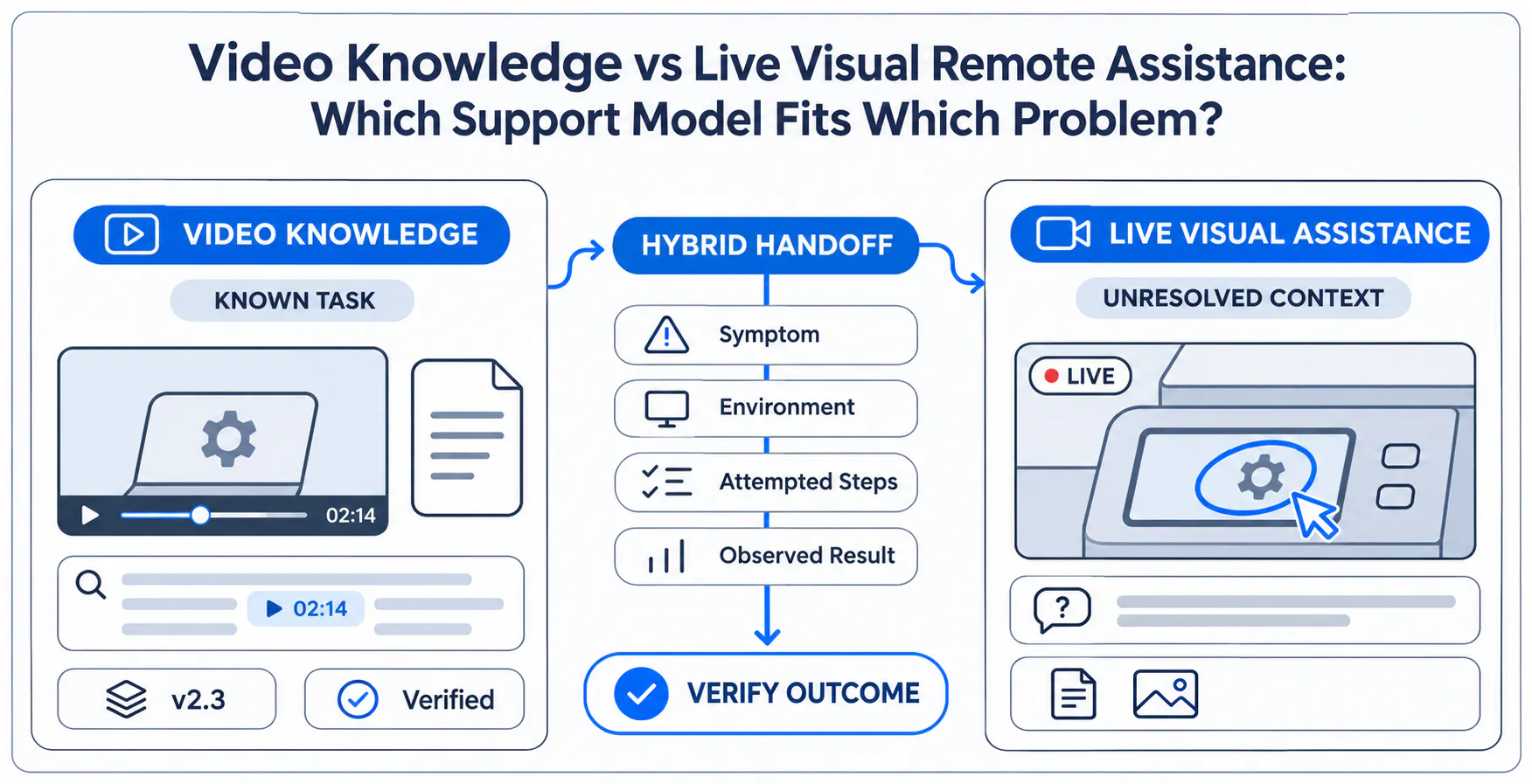
Video Knowledge vs Live Visual Remote Assistance: known guidance and unresolved context connected through a hybrid handoff and outcome verification.

Two support models can use video for different reasons

One customer needs a known setup procedure for a supported device. A maintained walkthrough, matching manual and success check may be sufficient. Another reports an installation problem whose physical context is unclear; an agent may need to observe it and ask questions.

Both hypothetical cases use video, but for different jobs: reusing an explanation versus gathering case-specific evidence. Choose the next step around the unresolved question rather than requiring every issue to begin with self-service or end with a call.

What video knowledge provides

Video knowledge combines reusable explanations and procedures with supporting materials so people can find and apply them. A useful resource identifies the task, product or model, prerequisites, expected result and escalation conditions.

Relevant video moments reduce searching, while the written reference preserves scannable detail. Start with an existing collection and give it clear scope and ownership. A played walkthrough is an interaction; success means the customer completes the applicable task and verifies the expected result.

What live visual remote assistance provides

Live visual assistance lets an agent observe a screen, device or environment and request clarification. It can help when an installation detail remains uncertain after reviewing the available explanation. A focused asynchronous exchange may still be sufficient.

Observation is distinct from remote control and does not automatically establish a diagnosis or authorize changes. Consider scheduling, connectivity, accessibility and the customer's readiness, and provide a workable alternative when a live session is unsuitable.

Compare the models across practical support needs

Use the comparison to understand practical tradeoffs rather than choose a universal winner. A familiar issue can need live help when the context differs; an unfamiliar one may still be clarified by an existing reference and a focused question.

Decision factor
Video knowledge
Live visual assistance
Issue familiarity
Strong starting point for applicable known guidance.
Useful when case-specific uncertainty needs observation.
Repetition
One maintained resource can serve recurring tasks.
Each interaction uses agent capacity; patterns can inform knowledge.
Interaction
Customer or agent consults prepared explanations.
Agent asks follow-up questions and changes the view.
Availability
Accessible on demand where published and permitted.
Depends on customer, agent, tools, and connection.
Agent effort
Production, review, maintenance, and assisted follow-up.
Preparation, session, documentation, and follow-up.
Evidence
Explains expected behavior; does not prove this case’s state.
Observes this case; does not alone prove root cause.
Reuse
Designed for repeated use within defined scope.
Findings need validation and sanitization before reuse.
Maintenance
Update versions, sources, and procedures.
Maintain agent skills, approved practices, and session tooling.
Issue familiarity
Video knowledge
Strong starting point for applicable known guidance.
Live visual assistance
Useful when case-specific uncertainty needs observation.
Repetition
Video knowledge
One maintained resource can serve recurring tasks.
Live visual assistance
Each interaction uses agent capacity; patterns can inform knowledge.
Interaction
Video knowledge
Customer or agent consults prepared explanations.
Live visual assistance
Agent asks follow-up questions and changes the view.
Availability
Video knowledge
Accessible on demand where published and permitted.
Live visual assistance
Depends on customer, agent, tools, and connection.
Agent effort
Video knowledge
Production, review, maintenance, and assisted follow-up.
Live visual assistance
Preparation, session, documentation, and follow-up.
Evidence
Video knowledge
Explains expected behavior; does not prove this case’s state.
Live visual assistance
Observes this case; does not alone prove root cause.
Reuse
Video knowledge
Designed for repeated use within defined scope.
Live visual assistance
Findings need validation and sanitization before reuse.
Maintenance
Video knowledge
Update versions, sources, and procedures.
Live visual assistance
Maintain agent skills, approved practices, and session tooling.

Route the problem according to what remains unknown

Check the symptom, applicable product context and what has already been tried. Choose the source or interaction that can resolve the remaining uncertainty, preserving any evidence the customer has already supplied.

Neither a library nor a video call automatically supplies current entitlements, telemetry or asset history. Use the appropriate authorized operational sources. Consequential actions also need their own approved workflow and qualified judgment.

The comparison of visual support and text-only answers can help determine whether the next step needs a demonstration, precise written guidance or both.

Support situation
Starting approach
Escalation trigger
Known repeatable configuration
Applicable approved guide and success check.
Result differs or scope does not match.
Familiar error with clear scope
Known explanation and approved checks.
Evidence contradicts expected behavior.
Unclear installation or environment
Focused context request; live observation if useful.
Unsafe access or specialist judgment needed.
Known procedure fails unexpectedly
Preserve attempted steps and observed result.
Remaining uncertainty merits observation or investigation.
Current account or device data needed
Authorized operational lookup.
Missing permission, stale data, or conflicting sources.
Consequential issue
Appropriate specialist and approved workflow.
Direct escalation; do not require self-service first.
Known repeatable configuration
Starting approach
Applicable approved guide and success check.
Escalation trigger
Result differs or scope does not match.
Familiar error with clear scope
Starting approach
Known explanation and approved checks.
Escalation trigger
Evidence contradicts expected behavior.
Unclear installation or environment
Starting approach
Focused context request; live observation if useful.
Escalation trigger
Unsafe access or specialist judgment needed.
Known procedure fails unexpectedly
Starting approach
Preserve attempted steps and observed result.
Escalation trigger
Remaining uncertainty merits observation or investigation.
Current account or device data needed
Starting approach
Authorized operational lookup.
Escalation trigger
Missing permission, stale data, or conflicting sources.
Consequential issue
Starting approach
Appropriate specialist and approved workflow.
Escalation trigger
Direct escalation; do not require self-service first.

Compare cost per resolution without ignoring hidden effort

Compare total effort across the case: preparation, agent time, follow-up, content production, maintenance, platform costs and repeat contacts. A short interaction can create more work if it leaves the task unresolved.

Stable recurring procedures often justify reusable knowledge; unusual contextual issues may justify live observation. Compare similar case groups and verified outcomes. Content is not free to maintain, and a call ending is not proof of a resolved problem. Include each model's ongoing work rather than assuming one is always cheaper.

Capture evidence separately from creating reusable knowledge

Case notes record findings. Customer screenshots and recordings preserve evidence. Reusable guidance explains a verified procedure to a defined audience. A live-session recording does not automatically serve all three purposes.

Record only when there is a clear purpose and suitable permission, access and retention arrangements. A concise note may be enough. Before reuse, review frames, narration, transcripts and attachments for customer information. A clean demonstration is often more appropriate than publishing the original conversation.

Design a hybrid handoff that preserves context

Carry the symptom, environment, resource version, attempted steps and observed result into the handoff so the next agent can investigate the real gap. A failed walkthrough should prompt an applicability check, not a demand to repeat the same failed task.

Use purposeful live observation only when it addresses the remaining uncertainty. Explain its scope and verify the result afterward. Route urgent or consequential cases directly to an appropriate specialist when needed. A hybrid model works through connected decisions, not simply two tools placed beside each other.

Turn recurring live resolutions into better guidance

Look for repeated resolutions that can become a maintained explanation. Have a subject expert verify that the procedure generalizes, define its scope and success check, and remove case-specific information before publishing.

Cincopa's VideoGPT can answer across available video and document sources, with exact spoken-moment links where timestamped transcript data is available. Review real questions and weak answers to improve that collection. Cincopa supplies the reusable knowledge layer here, not live assistance, remote control or an assumed integration with the live-session workflow.

Evaluate the hybrid model with representative cases

Pilot recurring known tasks, uncertain physical issues, failed procedures and cases needing another system or specialist. Use representative approved scenarios and compare results within similar case types.

Measure task completion, repeat contacts, total agent effort and handoff quality. Check whether recurring resolutions become useful maintained knowledge. Review failed cases to distinguish a content gap from poor routing, missing context or a technical issue. Views, session counts and duration describe activity rather than the customer's outcome.

Frequently asked questions

Video knowledge provides reusable approved explanations. Live visual assistance lets an agent observe and clarify a particular situation interactively. They can complement each other: guidance supports known tasks, while observation can address context that the resource does not establish.

When a maintained procedure applies, the customer can follow it, and a clear verification step can establish success. Offer another route when scope is uncertain or the result differs. Urgent or consequential issues may require direct specialist support.

It does not remove the need for maintained procedures, warnings, references, and reusable explanations. Agents also need approved knowledge during sessions. Likewise, a library cannot always resolve case-specific uncertainty that benefits from interaction. Design a connected workflow rather than assuming replacement.

No. Include production, maintenance, platform costs, follow-up, repeat contacts, and specialist effort. Stable recurring tasks may justify reusable material; uncommon contextual issues may suit live assistance. Compare total effort per verified outcome for similar cases.

No. Record only for a defined purpose under applicable organizational permission, access, and retention requirements. Case notes may suffice. A participant’s agreement to receive help does not automatically authorize recording or reuse of their information.

Identify repeated patterns, validate a generalizable procedure with a subject expert, remove customer information, and define applicability and verification. Update existing guidance where appropriate. Assign an owner and review trigger before publishing a clean resource.

Cincopa supports the video-and-document knowledge layer, including source-based VideoGPT answers and relevant video moments where the required source data is available. Evaluate live-session tools, operational records, identity checks, and authorized actions separately. Do not assume an integration between them.

Match the model to the unresolved problem

Use reusable video-and-document knowledge for applicable explanations, live observation for unresolved context and clear escalation when either reaches its limit. Preserve the handoff and verify the result, then use recurring questions to decide which explanation should improve next.

NEXT STEP

Connect reusable knowledge to your support flow

Explore the video-and-document knowledge layer with your own support questions. See where VideoGPT helps and where an operational or live-support workflow is needed.