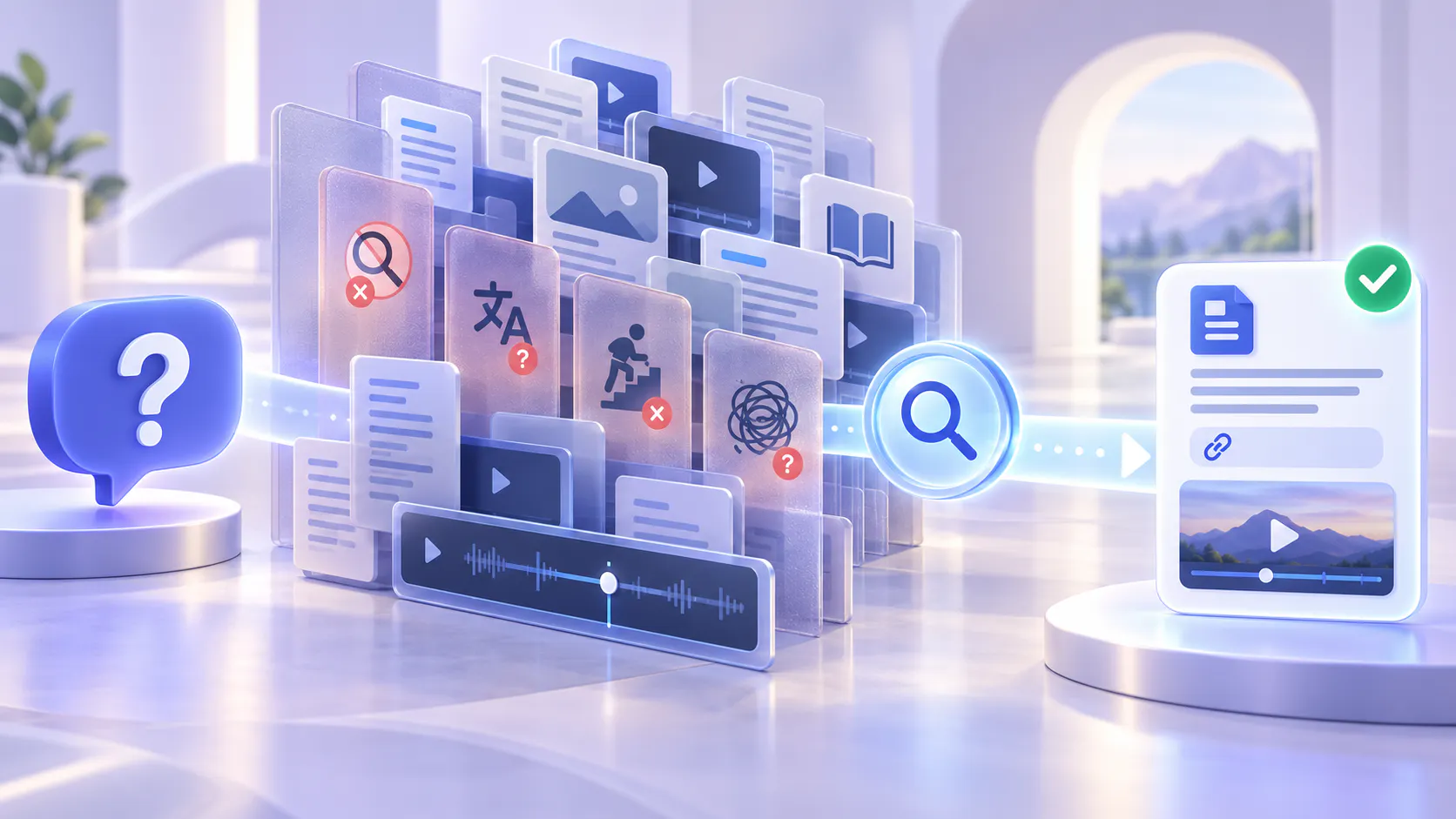
Why Customers Still Ask Questions When Documentation Exists
Customers need more than documentation that exists—they need answers they can find, understand and use. When guidance is buried in a help center, described in unfamiliar language or hidden inside a long training video, asking support may feel easier than searching.
This guide helps you identify where that journey breaks down and what to improve first, from search and wording to context and trust, before creating more content.
Documentation coverage is not the same as answer access
A company can have complete documentation and still receive the same questions from customers. The problem is often not missing information. It is the path between a customer’s question and the answer they need.
Customers may struggle to find the right source, use different words from the documentation, face too much effort to reach the answer, or find an answer that does not clearly apply to their situation. In some cases, they may find the answer but still not trust it enough to act.
The useful question is therefore not only “Do we document this?” It is “Can the customer find, understand, trust, and use the answer when they need it?”
Start with the customer’s actual question
When customers repeatedly ask questions that documentation appears to cover, start with the question itself.
Look at the wording customers use in support conversations, chat, search queries, sales calls, onboarding sessions, and product feedback. Compare that wording with the titles, terminology, and structure used in your documentation.
The gap between those two can reveal a findability problem even when the underlying information already exists.
1. The customer cannot find the right source
The answer may exist, but the customer does not know which document, video, guide, or section contains it.
A large documentation library can make this worse. More content does not automatically create better access to information. If customers have to open multiple pages, scan long articles, or guess which resource is relevant, they may return to support instead.
The goal is to reduce the number of steps between the question and the relevant source.
2. The documentation uses different language
Customers describe problems in their own words. Documentation often uses product terminology, internal terminology, or language chosen by the content team.
For example, a customer may ask how to “make a video private,” while the documentation may describe the same task using a specific product setting or feature name. The information is present, but the wording creates a search gap.
Review recurring customer questions and look for terminology that should be reflected in titles, headings, metadata, transcripts, or search experiences.
3. Reaching the answer requires too much effort
A customer may find the correct resource but still have to work too hard to extract the answer.
Long pages, unclear headings, buried instructions, and videos without searchable context can all increase the effort required. When the cost of finding an answer is high, asking a person can feel easier.
Good findability is not only about locating the correct source. It is also about reaching the relevant part of that source quickly.
4. The answer does not match the customer’s situation
Documentation can be technically correct while still being difficult to apply.
An answer may describe a feature without explaining the conditions under which it works, the required permissions, the relevant workflow, or what changes in a specific use case.
When customers ask follow-up questions after reading documentation, check whether the missing piece is context rather than another document.
5. The customer does not trust the answer enough to act
Finding an answer is only part of the problem. Customers also need confidence that the information is accurate and relevant.
Clear source attribution, current guidance, examples, and enough context to understand why an answer applies can reduce uncertainty. When customers cannot tell where an answer came from or whether it is still current, they may ask support for confirmation even after finding the documentation.
6. The question is not really a documentation problem
Some recurring questions indicate a product, workflow, onboarding, or UX problem rather than a documentation gap.
If customers repeatedly ask how to complete an action that should be obvious, adding another article may not solve the underlying issue. The better response could be improving the interface, changing the workflow, adding in-product guidance, or clarifying the product itself.
Use recurring questions as signals. They can identify problems beyond the documentation library.
When answers live inside videos and supporting documents
Some product knowledge is easier to demonstrate than explain in text. Product walkthroughs, training sessions, support recordings, and demonstrations can contain useful answers that are difficult to discover through traditional document search.
Cincopa’s AI Video Search supports questions across videos and supporting documents and can point users toward relevant source material and video moments. This can reduce the effort required to locate information that is already present but difficult to search manually.
Learn more about AI Video Search: https://www.cincopa.com/learn/ai-video-search
Fix the observed failure before expanding the library
When customers keep asking questions, resist the automatic assumption that more documentation is required.
First identify where the access path is breaking:
Is the right source difficult to find?
Is customer language different from documentation language?
Does the customer have to search or scan too much?
Is important context missing?
Does the customer need evidence or confirmation before acting?
Is the recurring question actually revealing a product or workflow problem?
Once the failure is understood, the right fix becomes clearer. Sometimes it is a better title or search experience. Sometimes it is clearer context, better source organization, or faster access to a specific moment in a video. And sometimes the solution is outside documentation altogether.
The goal: a shorter path from question to answer
A strong knowledge system is not measured only by how much information it contains. It is measured by how easily people can get from a real question to an answer they can understand, trust, and use.
If customers continue asking questions even when the information exists, investigate the path to the answer before creating more content.
Better findability can make existing knowledge more useful without requiring a larger documentation library.